|
|
When are Old Reports, Old Reports? |
| Wednesday, June 27, 2007 |
Two weeks ago, I completely cleaned my home office for the first time since moving into this house in June 1993. 14 years of junk was piled up. I Had stacks and stacks and stacks of papers that I accumulated. So many stacks. I found lecture notes and handouts used in classes over a decade ago. There were even course notes from my first class on creativity that I took with Gary Davis back in January of 1986 at the University of Wisconsin. I thought I had been doing a good job of cleaning up but I guess not. I am a pack rat.
Ok, 12 suitcases stuffed with old papers were taken to the Bloomington recycling center. So many old technical reports, research papers, and workshop handouts were terminated there. Oh that felt good. Just let it go. In return, I recovered many great paperclips--the hard fastener kind. But what was lost? I list a few things below.
1. Cutting Edge Thinking and Seminal Writing: I lost knowledge of those people on the cutting edge educational technology from the 1980s and 1990s. Sure, I kept the most seminal pieces. But what did I forget to save? What might I need someday? What did miss out on in return? Will an article be available digitally if I ever need it? I remember complaints from a doctoral seminar class I taught in 2002 when I included articles that were more than a few years old. I had them reading Seymour Papert, John Seely Brown, Ann Brown, Marlene Scardamalia, Roger Schank, Roy D. Pea, Elliott Soloway, etc. God forbid that some of their classic pieces were 10 years old. I told one of my nearly completed Ph.D. students about the accident Seymour Papert had in Hanoi, Vietnam and he say "Who?" Oh, it sometimes hurts to toss.
2. Memories: In those 12 suitcases where memories. I had so many a battle with those articles--to comprehend them and note what they were missing or what they had that was spot on--and then to use them in my own reports. Each article I read or skimmed has some of those memories. I had been saving this stuff for a reason. Was that reason now gone? Had I, in fact, given up on much of my own field or profession? Had I moved on or was I about to depart? Why was parting with so much of this stuff easy when just a year or 2 earlier, when I had thought about doing it, it was impossible? Had I changed? Was the intersection of educational psychology and instructional technology no longer important or interesting?
3. Expertise: Those who study chess players and other experts, find that expertise takes thousands of hours and perhaps 5-7 years of one's life to build up. So then was my expertise being thrown away? I did not have time or patience to scan 12 suitcases of stuff. Was I moving to a new field? If so, when and what was it? With such extensive amounts of information now gone, was I no longer an expert in the field of e-learning? Or, perhaps, expertise no longer comes from storing boxes and boxes and stacks and stacks of paper. Perhaps it never did. Perhaps we continue to recreate our areas of expertise. And perhaps this recreation process takes much less time than 5-7 years. With 21st century technologies, it is plausible to become an expert at something in a much shorter time span. And yes, we have many more people mascurading as experts simply because they are linked in to other experts from whom they siphon off knowledge when needed. There is good and bad in all that, of course. We have Google and Yahoo as well as collaborative networks in Facebook and LinkedIn to thank for that. We can email out friends with a question whenever one arises or ask for a missing resource that we perhaps mistakenly chucked. If most or our expertise is retrievable from somewhere at one's whim, then what is expertise anyway? And do we need to save papers we are sent or given links to anymore?
4. When is Old, Old? During my cleaning episode, I started to wonder about when my stuff I save really old. I was tossing any technical report that was older than 5 years old. That was one of the most troubling aspects of cleaning up my home office. Sure, I had many reports left and a few that I hung on to but perhaps should not have. I thought that perhaps my fall class would love to see these reports.
I kept many cool reports; including a 2005 report from Australia's ACT Dept of Ed and Training on emerging technologies, the 2002, 2003, and 2004 reports from the Sloan-C Consortium on quality online and blended learning, the Pew/Internet and American Life Project on the future of the Internet from January 2005, a report from the Innovation Advisory Council of New Zealand and one on e-learning opportunities in New Zealand that I got in 2002 during my trip there, 2004 e-learning guidebooks from the United Arab Emirates that I had received during my last trip there a couple of years ago, a report on the State of e-Learning in the United States from around 2000, a couple of ASTD reports including one on a vision for e-learning from 2000, the 1998-1999 Teaching at an Internet Distance: The Pedagogy of Online Teaching and Learning report from the University of Illinois which I helped with in a minor way, a 2005 report from Oxford's Internet Survey that I had just received during my trip there in January, UCLA's famous Internet Report on Surveying the Digital Future, a 2004 e-learning report from the National College of Ireland that I was given 2 years ago, and a 2006 report on Learning for the 21st Century from the Partnership for 21st Century Skills in DC.
I kept many others. But I tossed out 5-10 reports for every one that I saved. And how often will I read the ones that I saved? Perhaps not much. I kept them to share with my students as examples of reports that they might write. If not for that, many more would have found their way into the garbage bin; not because they are rubbish but because I do not really need them anymore. Old white papers and technical reports have a much shorter lifespan today then they did 10 or 20 or 30 years ago; especially those in educational technology.
5. Are My Old Reports, Really Old? So, as I was tossing out report after report, I started to get depressed. Not just because I missed the intellectual dances that I had with the writers of those reports or because I realized that I was 5 or 10 years older than when I first read them, but because I started to contemplate what was happening (or had happened) to many of the technical reports that I had done for others during the years. What about that 1999 report on asynchronous conferencing and collaboration I did for the Army Research Institute (Applying collaborative and e-learning tools to military distance learning: A research framework. (Technical Report #1107)), or the 2005 report Vanessa Dennen and I did for the Department of Defense on where the research needs to go on massive multiplayer online gaming (MMOG), or the 2004 Perfect E-storm report I did for the Observatory on Borderless Higher Education, and many others? I am sure many of those are history as well. But how long of a shelf life do these things really have? Are they worth doing anymore? They often take 6 months to a year to generate, if not longer. If they only are important for a couple of years, there is less incentive to do them. How long will any of our work be read? In the days of the heyday of Papert's book "Mindstorms," books like that would be welcome reading for at least a few years, if not a decade. Not today. Today we toss. But, of course, if is a good book, Google or Microsoft will likely have at least some of it available online. Still, I had many a depressing reflection about my own works when sending tons of reports from other people to the recycling. I even had fun throwing out my own papers!!!
6. When is New, New? Ok, today, my friend and colleague, Dr. KJ Kim sent an email to my blended learning research team with a note about the recent Sloan-C report called "Blending in: The Extent and Promise of Blended Education in the United States." This is a March 2007 report, so perhaps it is too old for most of you to look up and read. Given my recent Handbook of Blended Learning, it was interesting that this report revealed some decreases in blended learning in higher education. In fact, it noted that fully online courses were more slightly prevalent than blended courses. However, there were larger percentages of blended program offerings than fully online ones (such numbers I think will increase as the advantages of blended become more known). In particular, there were higher percentages of blended programs in business, education, healthcare, computer and info sciences, and liberal arts. Larger institutions were, not surprisingly, more engaged in blended learning than smaller ones. There are many more findings in the report. But when will this report also be old? When should we toss it? And do we even need it given that it is available online from Sloan-C. Why print it out anyway?
See these various Sloan-C links:
See the blended learning report: http://www.sloan-c.org/publications/survey/pdf/Blending_In.pdf
Become part of the new blended learning community: http://www.sloan-c.org/publications/survey/blended06.asp
See other Sloan-C blended resources and books: http://www.blendedteaching.org/node
So what should you save from your stacks is up to you. You will need to decide when old is really old but this is a constantly changing thing and so is your expertise. Right? Right!
Perhaps I am just getting old and cranky. But at least I have a clean home office to work from and view the birds, deer, and trees in the backyard now that the stacks of papers no longer are blocking my windows here in the basement. I wish I had some before and after pictures to share with you all. |
|
|
|
|
|
A week of hyperspeed e-learning publishing: R2D2 and Beyond!!! |
| Saturday, June 16, 2007 |
This was a highly productive and somewhat strange week from an academic publication standpoint. I never had such a week before--we hit hyerspeed about half-way through it. As an example, I sent a book manuscript off to Jossey Bass for the production process this week after months of haggling about the title and length of the book. It is about my R2D2 model. Here is the title or current citation:
Bonk, C. J., & Zhang, K. (in press). Empowering Online Learning: 100+ Activities for Reading, Reflecting, Displaying, and Doing. San Francisco, CA: Jossey-Bass.
In the picture below, Ke Zhang and I display our R2D2 talents.

I guess it will be out in 6-7 months or so. I hope by Xmas so I can send it to family and friends as a Xmas gifts but who knows. If you cannot wait until Xmas to learn about the model, write to me and I will send you what I can (perhaps the preface), or read the following:
Bonk, C. J., & Zhang, K. (2006). Introducing the R2D2 model: Online learning for the diverse learners of this world. Distance Education, 27(2), 249-264.
The above journal article summarizes the R2D2 model and provides many examples, though we modified it slightly in the book. Below is a brief summary of the book pulled mainly from content that was deleted from it prior to the production phase.
Brief Summary of the R2D2 Model and the Book
Ok, below, I provide some comments related to R2D2 that we deleted from the book before sending to Jossey Bass (Note: 6 chapters were deleted from this book (chapters on online learning trends (originally Chapter 1), learning styles and preferences (Ch 2), different generations of learners (Ch 3), problems with LMSs and CMSs and training instructors online (Ch 4), comparisons of R2D2 to other models and our MATRIX model (ch 15), future directions of the Web of Learning (Ch 16)). I can send you some of these if you like...just ask.
As I indicated, the book goes through the R2D2 model (Read, Reflect, Display, and Do)--Note: we could not use R2D2 in the title due to concerns related to Star Wars repurcussions. There are 25 sample activities for each phase of the model or 100 ideas total and for each activitiy, Ke Zhang (my collaborator) from Wayne State University and I go through at least one variation or extension so there are more than 200 activities and ideas for fully online and blended learning courses in the book.
In effect, R2D2 is a relatively simple instructional design model that offers a macro lens on the processes that an instructor or instructional designer might want to consider in designing, building, or moderating an online course or module. It simultaneously provides a window into specific ideas that might help in the successful delivery of a course or module. It is more a problem solving process than it is a way to address learning styles. In part, it is a motivational model, a problem solving model, an instructional design model, and a learning preferences or styles approach. Or maybe it is none of that (Note that neither Ke or I believe that any learning style approach is valid or reliable but they do encourage instructors, instructional designers, course developers, and administrators to think about the varied and diverse needs of their learners).
Ke and I intend for the R2D2 acronym to be an easy mnemonic for instructors as well as students to remember. It is a label that distance educators and researchers can use to discuss the quality of an online course and perhaps structure the redesign of it. Clearly, it is advantageous that the Read, Reflect, Display, and Do (i.e., R2D2) model is easy to remember and can be applied in a versatile manner! It might be used as a general evaluation framework for a course, set of courses, or a program, or as a specific tool for generating interesting and engaging activities within fully online or blended courses.
Ke and I also hope that thoughtful use of our model can lead to transformative blended and fully online experiences. Of course, this book offers a few windows into how this might occur. Those reading this book should keep in mind that what was possible in the Web of Learning at the time of this writing was scarcely imagined a few short years before. The same will undoubtedly be true in a few years.
Diversity
Instead of focusing on distinct learning styles or approaches, the aim of this book is essentially to address diverse learner needs. By the term of “diverse,” we do not intend to directly address diversity from the standpoint of social, ethnic, or race-related criteria (though it might). Instead, the notion of diversity here relates to the varied interests, particular learning preferences, generational differences, and special learning needs in online learning. The R2D2 model offers a starting point for online instructors to understand the diverse nature of e-learners and become better able to address their diversity.
Intended Value of the Book
For each of the four key types of learners, the R2D2 model suggests a variety of learning activities for active and effective online learning with various distance learning technologies. In Chapters Three, Five, Seven, and Nine, we detail twenty-five or more online learning strategies for each of the respective quadrants or phases of our model. R2D2 is an easy-to-apply, practical model that helps achieve active learning through four types of activities: (1) reading, (2) reflecting, (3) displaying, and (4) doing.
The “Empowering Online Learning” book (I preferred "E-Powering E-Learning") should find value for online instructors, trainers, instructional designers, and designers of web-based courseware or course management systems. For example, this book introduces the R2D2 model as a practical and easy-to-apply mechanism for online instructors to integrate various learning activities for different types and generations of learners. With a solid theoretical foundation and practical guidance and examples, it may work as a quick, practical guidebook for online instructors, trainers, and instructional designers. In effect, this book is intended to help readers with the design, development, and delivery of learner-centered online learning. At the same time, there are ideas and examples that are more instructor-led as well; if one prefers such options.
Open Issues of R2D2
As with any new idea or model, there are numerous open issues and questions that remain to be sorted out as well as various limitations that must be disclosed. One limitation is that there are an assortment of ideas that cut across multiple phases of the model. Given that many of the 100+ strategies detailed in the book do not fall squarely in one quadrant or another, some online educators may get confused when applying R2D2. Of course, this is a perennial problem related to the lack of validity of learning style approaches and any scheme or framework that attempts to label or somehow segment human learning. Certainly, an equally problematic aspect of R2D2 is that it has yet to be widely used or embedded in blended and fully online courses.
The model or framework provided by R2D2 can help new as well as experienced users of the Web of Learning (i..e., the new name Ke and I gave to the Web) better grasp what is now possible, while perhaps helping glimpse what might be possible in the tomorrows to come. No longer must we remain passive browsers and polite connoisseurs of the Web of Learning. In contrast, we can exploit Web 2.0 technologies and beyond which allow learners to engage in reflective as well as participatory learning wherein they build, tinker with, and share their learning. The use of the R2D2 model will provide guidance for professional educators wanting their learners to generate ideas online as found in the use of podcasts, wikis, blogs, virtual worlds, and social networking software.
Consequently, it is critical to determine how easy it is to train instructors in the use of this model. At the same time, stakeholders will want to know if student retention increases when instructors are properly trained to use this model. Are students more satisfied in courses wherein the instructor had training in how to use R2D2? Do achievement scores go up and are such gains higher in courses that use the R2D2 method over those that do not? And is there a greater opportunity for learning transfer from one context to the next when this model is successfully applied? And, of course, can it take your online instruction to hyperspeed?
The jury is still out on whether the pre-assessment of learning styles, whatever their format or components, can help instructors and trainers better deliver online and blended courses. While it is just one framework, the R2D2 model is a means for instructors to consider online learner needs and learning activities in four different phases or aspects of learning, thereby providing a more enriching and stimulating environment for learning. At the same time, R2D2 makes available a problem solving process that shifts instructors and instructional designers from an overriding focus on the acquisition of content knowledge and basic facts to active learning and reflection including the visualization of one’s learning.
Final Comments in the R2D2 Model
The explosion of online learning events, activities, courses, and programs during the past decade have only scratched the surface of what is currently possible while scarcely hinting at the opportunities of tomorrow. As a result, during the next few years (or decades), researchers will likely compile extensive information about how to address learner needs using models such as R2D2. There will definitely be significant inroads and advances made in personalizing and customizing fully online and blended learning environments. R2D2 certainly pushes us in that direction, but it is clearly not enough. We all have to do more! What will you do to make a contribution toward understanding and using the Web of Learning? May R2D2 take you and your learners to places where no instruction has gone before! Engage!
Other Publications and In Press Stuff this Week...
I also had a whole bunch of stuff published this week and other stuff going to press including 4 chapter reprints in a mammoth book that the Information Science Reference (i.e., Idea Publishing) people are putting together. It is a six volume monster with 200 chapters on online and distance learning. It will sell for a mere $1,750 and is set to come out in July, 2007. I think I may have the most chapters. You can get more information at http://www.igi-pub.com/reference/details.asp?id=6923. A sample of one of my chapters is below.
Bonk, C. J., Wisher, R. A., & Lee, J. (2008). Chapter 1.47. Moderating learner-centered e-learning: Problems and solutions, benefits and implications. In L. Tomei (Ed.), Online and distance learning: Concepts, methodologies, tools, and applications (pp. 536-561). Hershey, PA: Information Science Reference.
I have 3 more chapters being reprinted in there (perhaps the most of anyone in this book...not sure yet). It was quite a surprise to me that they were being reprinted.
Some other publications this week are noted below.
One book chapter went to press in a second edition of the Encyclopedia of Distance and Online Learning. As indicated by the title, this article one explores how to take a learner-centered approach with online instruction:
So, H. J., Bonk, C. J., & Wisher, R. A. (in press). A learner-centered perspective on e-learning: Mounting possibilities. In P. Rogers, G. Berg, J. Boettcher, C. Howard, L. Justice, & K. Schenk (Eds.). Encyclopedia of distance and online learning (2nd edition). Information Science Reference.
Ok, perhaps more importantly, two journal articles were published this week. The first one below is one of many on instructor perceptions and suggestions regarding online learning though we attempted to end it more uniquely than most on this topic. A earlier version of the second one below one an outstanding paper award at the eLearn conference in Hawaii in October 2006.
Liu, S., Kim, K-J., Bonk, C. J., & Magjuka, R. (2007). Benefits, barriers, and suggestions: What did online MBA professors say about online teaching? Online Journal of Distance Learning Administration, 10(2), see http://www.westga.edu/~distance/ojdla/summer102/liu102.htm
Liu, X., Magjuka, R., Bonk, C. J., & Lee, S. H. (2007). Does sense of community matter? An examination of participants’ perceptions of building learning communities in online courses. Quarterly Review of Distance Education, 8(1), 9-24.
In addition, a book chapter came out early this week (co-published with my colleague, Dr. Vanessa Dennen from Florida State University) that summarizes many of the frameworks I have designed for online learning environments during the past decade. It is in Michael G. Moore's Handbook of Distance Education (it is an updated article to what we had in volume 1 of this handbook). I recommend this book given the number of well known scholars he has contributing to it (e.g., Randy Garrison, Zane Berge, Terry Anderson, Robin Mason, Sir John Daniel, Michael Hannifin, Farhad Saba, Som Naidu, Janette Hill, Linda Wilcott, Tom Clark, Donald Hanna, Charlotte Gunawardena, Chris Dede, Walter Archer, Rick Shearer, Marcy Driscoll, Michael Simonson, etc.). Apparently, Michael G. (note the "G" here) Moore knows a ton of important folks in the distance learning field. Well, he has been at it for some time so he should. Great book. I highly recommend it as it is even better than the first edition and quite a bit lighter to carry around. Here is the chapter from Vanessa Dennen and myself:
Bonk, C. J., & Dennen, V. (2007). Frameworks for design and instruction. In M. G. Moore (Ed.), Handbook of distance education (2nd Ed.) (pp. 233-246). Mahwah, NJ: Lawrence Erlbaum Associates.
On top of that, a key technical report (or minibook) came out Wednesday that was produced by Brandon Hall Research (http://www.brandon-hall.com/). I got a copy Thursday. It looks great though it does cost $595. Pictures and bios of my entire blended learning research team are in there. More information on it is here http://www.brandon-hall.com/publications/blendedlearning/blendedlearning.shtml. This is aimed at blended learning in corporate training settings. Our section of the report relates to strategic planning for blended learning in corporate training settings in 5 countries--Taiwan, China, Korea, US, and the UK.
Teng, Y.-T, Bonk, C. J., Kim, K-J., Oh, E. J., Son, S.-J., Zeng, T., & Cheng, J. (2007, June). Strategically planning for blended learning: A cross-cultural comparison. In J. Clarey (Ed.). The real story: Blended learning (pp. 101-114). Sunnyvale, CA: Brandon Hall Research.
Ok, that is a sample of some of the articles I had come out this week or go to press. There were more and a few others sent out for review. Now I am finally (yes, finally!) working on my Learning World is Flat book. Been talking about it for more than 18 months. After that is done, I will write a book related to online motivation and retention which will outline my TEC-VARIETY model. The World is Flat book will be my summer 2007 project and the other one will be my project during the fall of 2007 and spring of 2008 or so I hope. Who knows...these are just goals.
Due to my focus on book writing, I will be missing the Ed Media Conference in Vancouver in a week or so. I have been going every year since 1999 so this really hurts not to go. As my post on Canada below notes, I love Vancouver in June. So many friends and colleagues will be there. There are some wonderful researchers who present at Ed Media each year--many from Australia. The Aussies travel well. Oh, tear, tear, cry, cry. I will also not be going to the annual distance teaching and learning conference at the University of Wisconsin (my alma mater) in August. More tears to shed!!!!!!
Ok, send me notes if you want to know more about my Empowering Online Learning book or about any of the other book projects I mentioned here. I am sure I will be adding a blog post when the book is closer to publication though you can likely inquire with Jossey Bass about ordering a copy soon. I am pretty sure it will not arrive by hyperspeed or Warp 9, but it will get there someday. Until then, full impulse power. |
|
|
|
|
|
Oh Canada...10 E-Learning Memories from 9 Trips in 2 Years. |
| Wednesday, June 13, 2007 |
Ok, this posting is a chance to me to reflect on many trips I have had recently to the Great White North as some refer to it as--though with global warming I have rarely seen snow there. I have been in Canada for 9 different trips in 2 years starting with Ed Media in Montreal in June 2005. That was memorable indeed! Jazzfest. And my sabbatical started a year ago with a 3 city tour of Canada--talks in Saskatoon, Calgary, and then Edmonton. Much to do there! Many people to show me around! Thanks to everyone for that! From Barry Brown in Saskatoon to BJ Eib, Norm Vaughan, and Randy Garrison in Calgary, and John Boyle, Guohua Pan, and many others in Edmonton. It was great to be on radio, 3 TV stations, and the newspaper one day in Edmonton. Pics from Saskatoon are below with 3 professors, Barry Brown, Rick Schwier, and Earl Misanchuk, there who all got their degrees in my department at IU a few years earlier (smile). They are doing the Indiana "I."
 
Pics from the Calgary portion of that trip are below (note that they made me wear the Calgary Flames shirt for my journey up to Edmonton where the Oilers play hockey. Smile.)
 
(Note: above is Norm Vaughan and myself in one picture and the whole group in the other.)
 
(Note: one pic above is of me and Randy Garrison; the other is of me with BJ Eib and Pam. BJ and Pam used to work in Indiana. BJ worked at our Center for Excellence in Education (CEE) in our School of Education where she brought in tons of teacher training grant money. We are doing the Indiana "I" in this picture.)
I have been to Canada 3 times in a little over the past month; first to Mohawk College in Hamilton to speak on how the learning world has become flat and also on strategies for teaching online (see http://connections.mohawkcollege.ca/). Next I gave a keynote at a conference at Concordia University in Montreal (see http://spirit-of-inquiry.concordia.ca/keynote.shtml). See pic below with Arshad Ahmad from the business school at Concordia. Finally, last week, I spoke in 3 different places in 3 days to begin to wind down my sabbatical as it all started--with a 3 city speaking tour in Canada..only this time in the eastern time zone instead of Rocky Mountain time. I have gone from west to east. I still need to get to more provinces, however.

In my most recent 3-4 days in Canada (June 3rd-6th), I spoke to teachers in the York district in Newmarket (just outside Toronto thanks to Janet Murphy's excellent coordination), graduate students at York University in Toronto (my first grad class since this sabbatical began--thanks Ron Owston--see Flickr for pictures or see below).
 
The Orion conference in Toronto (see http://www.orion.on.ca/2007orionsummit/home.html), and then Fanshawe College in London, Ontario. I took a shuttle service from Toronto to London; otherwise friends and taxi's drove me from place-to-place. Lot of friends! See some of those at Orion conference below (observing a presentation on an anatomy course in 3D). 
Now after all these trips let me make some quick observations.
1. E-Learning Leader: The majority of my speaking invites related to e-learning and blended learnig lately are from those in Canada and the UK. This indicates either that they know I like a good beer and conversation or that these 2 countries are assuming leadership in this field or attempting to do so. Perhaps it is both! Notice that Ed Media is back in Canada in 2 weeks (in Vancouver) and eLearn is in Quebec City in October. Maybe there is more government support for e-learning in Canada than here in the States where we lack e-learning leadership from the government. A recent study I did in corporate training departments in 5 different countries showed that government support for e-learning and blended learning was high in the UK and Korea and lagged behind in the USA, China, and Taiwan. We did not study Canada in that one. I guess we should have.
2. Cross-Institutional Collaboration: I notice that in the Canadian higher education workshops I do are typically jointly sponsored and open invite (i.e., anyone can attend for free). As a result, there are often people from many local colleges traveling to another one for a conference or event. Or an event is broadcast using Webstreaming or videoconferencing. The sharing, networking, and collaboration among and between institutions of higher learning as well as the corporate sector in Canada is stunning. I have noted similar things in the UK. People in the UK travel well due to the size of their country and they can use trains (a conference in the middle of the country, say in Leicester, is only 2-3 hours for nearly anyone to travel to by train). In Canada, it may be that share and collaborate well and invite people from nearby places due to its enormous size.
3. Sponsors: As I said, in Canada, there are sponsors for these e-learning conferences. People like Joe Sandercook from McGraw-Hill Ryerson and others have done a marvelous job of sponsoring my talks in Canada. I rarely see the same thing here in the USA. It is really heartwarming when someone calls me up and says "hey, Curt, we have a regional conference in Moose Jaw and we would love for you to be a keynote speaker there." Unfortunately, I have yet to be to Moose Jaw or Yellowknife but perhaps someday. McGraw-Hill Ryerson, like any company is profit-driven, but it is one few companies that truly seems interested in moving the field of educational technology and e-learning ahead. As a former CPA and corporate controller, it is good to see some genuine interest in the ultimate user of their products--the faculty members and the students. Thanks Joe!
4. Inquiry-Based Learning: Only in Canada do I get requests to speak on inquiry-based learning. Most recently, some folks at the University of Guelph (near Toronto) wanted me to speak on it. Unfortunately, we could not come to a date and time. Interesting, back in November 2005, I noted that the University of Calgary has a funded blended learning initiative wherein faculty members can get funded for their blended learning course projects if they include an inquiry component. See success stories at the Learning Commons department at the University of Calgary: http://commons.ucalgary.ca/. Why is inquiry-based learning not more prevalent in the USA or other countries that I visit? Is this a direction we should head? Does online learning provide more rich and powerful opportunities for it?
5. Blended Learning: A hot topic in Canada right now is blended learning. People like Norm Vaughan and Randy Garrison at the University of Calgary are doing a more practical and higher education focused book than my Handbook of Blended Learning which has both higher education and corporate training components. Their book will be coming out soon with Jossey Bass or so I think. Randy and Norm are also currently offering a course on blended learning. I said, a course on blended learning. Wow!!!!!!!!!! I am not sure that would fly here at Indiana. I have had many people in my TravelinEdMan journeys ask my if IU could offer a master's or Ph.D. in blended learning or e-learning and I have to tell them regretfully no.
Dr. Rick Schwier at the University of Saskatchewan in Saskatoon told me last month (he was here on sabbatical) that they are also offering such a course on blended learning. And blended is not just hot at Canadian Universities. For instance, when at the Northern Alberta Institute of Technology (NAIT), they had me do a talk on blended learning that they sent to 35 or so sites in Canada as well as to Alaska and Saudi Arabia. I also did a blended talk in Saskatoon a few days before it which is a Google video now (see http://video.google.com/videoplay?docid=8666613122467962929&q=curtis+bonk&hl=en). Last week, I spoke on blended learning to graduate students at York University, to instructors at Fanshawe, and then to end my trip, I gave an overview of blended learning to Fanshawe administrators. The Canadians sure seem to like blended learning as much as they do hockey...well, maybe not that much. These are just a few examples. Perhaps it is because, like me, they believe in getting learning out in as many formats to reach as many people as possible. They have a diverse population and significant geography to traverse with their courses. Perhaps the Canadians are simply taking a leadership role. Perhaps one should read Ron Owston and Randy Garrison's chapter in my Handbook of Blended Learning to see what is going on in Canada in the area of blended learning or wait for Randy's upcoming book.
6. Facebook: When I spoke at Concordia University in Montreal a few weeks ago, I showed my Facebook account and noted that I only had 2 friends in 1 year of using Facebook (and one was an acordian player from Germany I had never met). Now, less than a month later, I have more than 20 friends in Facebook and it is growing every day. Seems many Canadians felt sorry for me. Also, I have been told that Facebook has a huge presence in Canada; especially in the Ontario province. Interesting--why are the Canadians fascinated with Facebook? In the past week, however, I have had people from countries such as Australia, the USA, and the UK contact me through their Facebook accounts. So maybe, Facebook is starting to take off among us adults across the planet. Someone should study this!
7. OISE is Poised Again: When I was a graduate student at Wisconsin in the late 1980s, my colleagues and I were always reading information from the Ontario Institute for Studies in Education (OISE) at the University of Toronto. It was always highly grounded in theory and yet had a practical bent to it. People like Marlene Scardamalia, Carl Bereiter, and Gordon Wells have always been welcome reading. Marlene and Carl led the research field on computers and writing and continue to do so. Their psychology of writing papers and books were an inspiration to my own dissertation on computer prompts and writing and keystroke mapping of that writing. Anyway, I have meet a number of people during the past few trips to Canada who have recently completed dissertations at OISE on various collaborative technologies. Once again, it seems that OISE is facilitating many interesting studies (see picture below from Olivia Roberson from OISE who just graduated with a dissertation related to online collaboration processes and stages). Way to go OISE and Olivia!
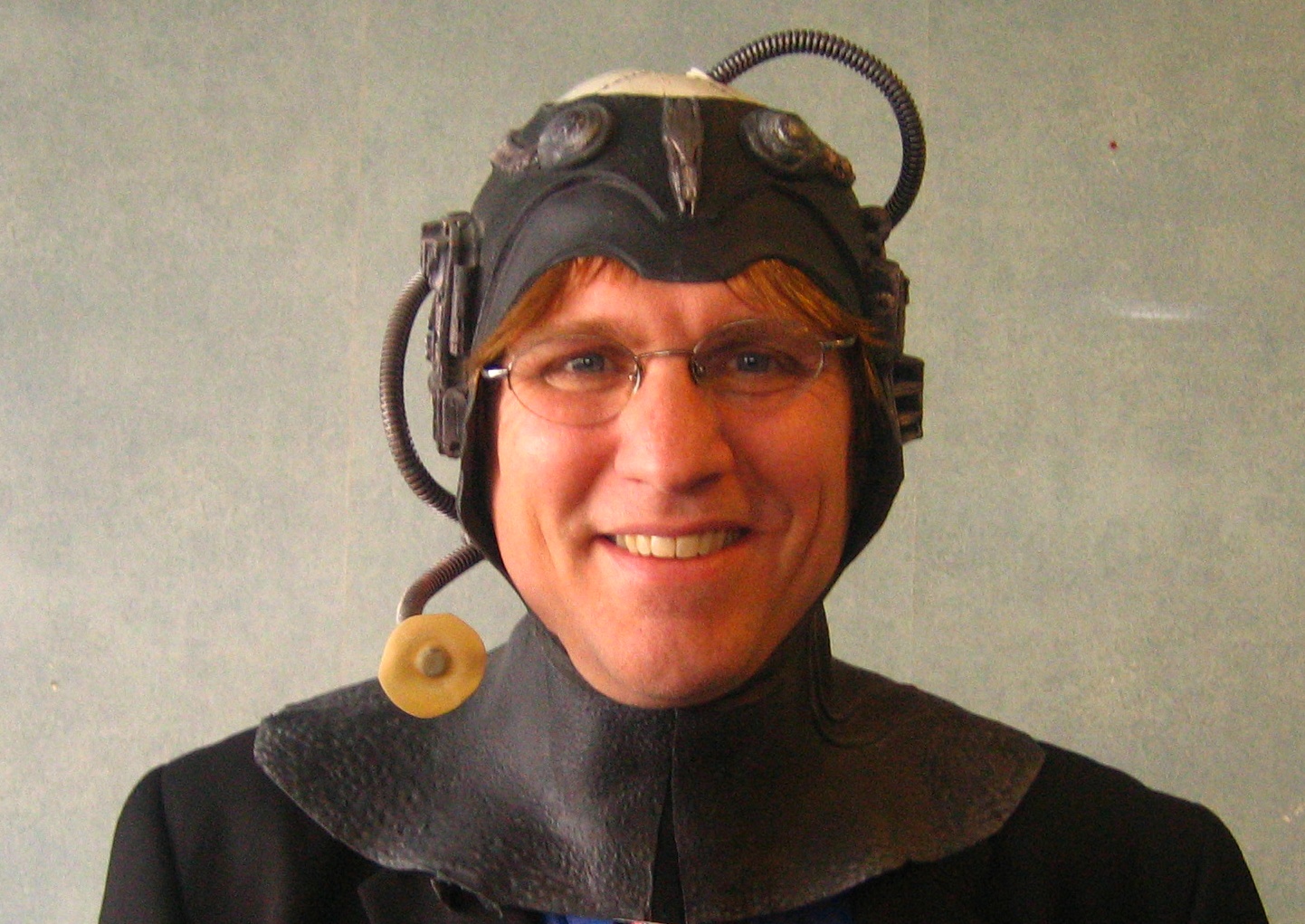
 8. May Day: The past few years I have been to Canada for inservice workshops in May and June. May and June apparently are the months when colleges and universities are in summer session and instructors can come in for some training. Here in the US, this might more often be June and July or never (smile). In Canada, it just seems expected that professors and instructors will engage in retooling during May or June. Many (though not all) realize that the world is changing and they better learn what is possible. Sure, there are still many who are reluctant, resistant, reticent, and hesitant. But, hey, as Bonk is Borg will note, "Resistence is Futile" (see http://www.trainingshare.com/images/BonkasBorg.jpg or http://www.trainingshare.com/workshop.php). Some reading this post will say, well we have training at my campus here in the US. What is Bonk talking about. Well, when you compare the number of higher education institutions in Canada and the US, and realize that I have spoken at 3-4 times as many Canadian colleges and universities than US ones during this sabbatical, you have to at least note it. Ditto the UK compared to the USA. Perhaps US people hate me. Or perhaps they do not like a good conversation and a beer as those in Canada and the UK do.
9. In Canada, E-Learning Friends are Friends for Life: I am on sabbatical now. Been on it for 14 months with a little over 2 months to go. Big sigh and an ug!!! Back in the fall of 1998, I did part of my last sabbatical at Simon Fraser University (SFU) at their Burnaby campus in Vancouver at the top of a mountain. What a lovely place it is. Wish I could go to Ed Media in Vancouver later this month, in fact. Back in November 1998, I got a chance to hang out with Linda Harasim's research team where the TeleLearning Centres of Excellence were headquartered. Linda had quite a wonderful research team assembled there--Cindy Xin, Brian Fisher, Milton Campos, Sylvia Curry, etc. And she kindly introduced me to many people who came to the TeleLearning conference there that month. People like Ron Owston from York University and Robin Mason from the Open University. They all remain friends today! See pics of Milton and I in Toronto in May. First time I have seen him in years yet he remains a great friend.
I got emails from Cindy, Brian, Milton, and Ron in the past 1-2 days. And there is talk of many of us getting together at Milton's new house near the Vermont border just outside Montreal. My career perhaps had started taking off the year before in Finland, but those weeks in Vancouver were wonderful since I was able to meet many e-learning friends for life. Perhaps I need to move to Canada. I grew up in Milwaukee, so not far in terms of accent.  .JPG)
10. Canada has Stephen Downes: Stephen reads everything in the field of educational technology and online learning and often summarizes them so well that you do not have to read them--just read his blog (hec, he is likely one of the first to read this blog post--though his blog says he is in Taiwan now with limited access and is about to travel home.). And, unlike many of us who publish just for the sake of tenure, he is passionate in his writing!!! As I indicated, Stephen will often read and review articles on emerging technologies so that you can decide whether to read the article yourself or use the particular technology. He will blog on a conference that perhaps you could not get to. I attend many conferences each year but remain amazed by the number that Stephen gets to. Stephen's blog is perhaps read by more people in higher education than anyone else. Do the Canadians know how well he places Canada on the e-learning map. If you were at a dinner party and someone said "educational technology" and "Canada" in the same sentence, I think most would immediately think of Stephen Downes. Thanks for all the fantastic posts Stephen! You are an e-learning institution.
See http://www.downes.ca/
http://www.downes.ca/news/OLDaily.htm
Well, that is 10 things I have to say in recapping all these trips to Canada over the past 2 years. (Note that I have been to the UK 10 times in a little over 2 years and 9 times to Canada in less than 2 years; I am curtailing my travel now in order to write more books. TravelinEdMan will still exist, but his ideas will have to travel electronically more often than in the past).
Of course, I have enjoyed these visits to Canada but I am getting a tad worried that I am starting to speak Canadian. Haw bout dat huckey game, eh? Ok, I better sign off now, before someone calls me a hoser. Just post it you hoser. Ok...here it goes. |
|
|
|
|
|
|