|
|
Adding up the numbers for "Adding Some TEC-VARIETY" |
| Sunday, September 02, 2018 |
Download Updates for "Adding Some TEC-VARIETY":
People ask me if making my book, Adding Some TEC-VARIETY: 100+ Activities for Motivating and Retaining Learners Online, free and open was a good decision. Well, due to the openness, it is available for free in Chinese as well. Since it came out in May 2014, there have been over 100,000 downloads of the book from the book homepage, including 90,000 in English and 10,000 in Chinese.
The countries which have downloaded it the most are:
1. USA
2. China
3. Canada
4. Australia
5. Germany
6. Great Britain
7. Russian Federation
8. New Zealand
9. India
10. Poland
11. Finland
12. France
In addition, my book co-author, Dr. Elaine Khoo, at the University of Waikato, just informed me that their library in New Zealand has made the book available at a special book website. It has been downloaded 18,536 times from there. Countries that have the most downloads from that site (in order) include the USA, France, China, the UK, Finland, Romania, Germany, South Korea, the EU, Poland, Russia, Indonesia, Sweden. the Ukraine, Canada, Guinea, Australia, New Zealand, Thailand, Japan, India, Serbia, Spain, Italy, Vietnam, Malaysia, Brazil, Luxembourg, the Philippines, and Pakistan. In terms of specific cities, it is most popular in Beijing, Malvern (PA or UK?...I am not sure), Kerava (southern Finland), Seoul, Newhaven (CT), Davis (California), Dallas, Seattle, Georgetown (DC), Henderson (Nevada), Chicago, and Kansas City. Such geographic data is always interesting to me.
In addition, individual chapters have been downloaded over 65,000 from the book homepage. The chapters on engagement (Chapter 11 has had 7,825 downloads) while Chapter 6 on Curiosity (is now at 6,422 downloads), Chapter 4 on Tone and Climate (5,767 downloads), and Chapter 13 on Goal Setting (5,120 downloads). These are the most downloaded chapters. But these statistics do not include the downloads for the preface (4,312 downloads), references (7,446 downloads), and Web resources (9,450 downloads) sections. So the references are the most downloaded. Why am I not surprised. When you add in these numbers, the total chapter or section downloads is over 86,000.
People ask me if I would do it again? Keep in mind that this data is just from website in which I am aware of. There are likely more places which have posted this book since it is free to share and download. Additionally, there are likely countless numbers of sharing of the book between friends, students, colleagues, and work teams. So, given nearly 120,000 downloads of the entire book from just these two websites that I know about and another 86,000 chapter downloads from just one website or over 200,000 downloads for some part of the book, I should say yes, I would.
But I am not sure if want to do a second book as free and open at the present time. Time will tell.
Labels: book downloads, Elaine Khoo, free and open books, online motivation, TEC-VARIETY, University of Waikato |
|
|
|
|
|
Introducing the "PEERS Framework": Quality control for book self-publishing |
| Sunday, November 27, 2016 |
Part 1: Updated “PEERS” Framework
Quality Control for Self-Published TEC-VARIETY book
November 2016
Back in May 2014, I self-published a book related to online motivation and retention (see blog post from two years ago). This particular blog post concerns the peer review process (PEERS) that we put the book through. It only took me 2.5 years to finally finding some time to make this post.
It is important to point out that I originally dreamed of this book back in 2000 with my colleague Vanessa Dennen of Florida State University ( Vanessa's blog). It only took 14 years to come to fruition. And my co-author was Dr. Elaine Khoo from the University of Waikato in New Zealand, while Vanessa became one of the book editors.
The book title: is “Adding Some TEC-VARIETY: 100+ Activities for Motivating and
Retaining Learners Online.” This book offered a new framework for
online motivation called TEC-VARIETY. Each letter of TEC-VARIETY stands for a set of overlapping motivational
principles. There are 100 activities in the book (10 for each principle of
motivation). Online instructors can learn how to foster curiosity, design a
safe climate for learning, give feedback, foster interaction and collaboration,
nurture student autonomy and creation of products, and much more. The intent is
for higher online learning retention and the development of more self-directed
online learners.
With the 100+ activities, it follows the same format as my Empowering Online Learning book
published by Jossey-Bass back in 2008 with a model called Read, Reflect,
Display, and Do ( R2D2) ( Amazon). This new TEC-VARIETY book has a brand new set of 100+
activities and a focus on learner motivation and retention.
Elaine Khoo and I made this book free as an e-book. We used Amazon CreateSpace as our publisher along with OpenWorldBooks (which I own). AmazonCreateSpace were some of the most wonderful people in the world to work with. They were highly polite and customer service oriented.
To date, over 80,000 people have downloaded
the entire book in English and tens of thousands more have downloaded individual chapters.
Scholars at Beijing Normal University in China have recently translated it to
Chinese (also free as an e-book) and the Open University of China has published
it in print. Anyone can now download, share, and, with permission, translate it
in English or Chinese. By the way, my son Alex produced the book cover.
A common question of self-published books relates to quality. See below for the "Peers framework which I designed and used for this book so as to address quality. Others might find it a handy guide when self-publishing their own books.
Reference: Bonk, C. J., & Khoo, E. (2014). Adding Some
TEC-VARIETY: 100+ Activities for Motivating and Retaining Learners Online. OpenWorldBooks.com and
Amazon CreateSpace. Note: Free eBook available
at: http://tec-variety.com/
PEERS Framework (for review of a
self-published book):
1.
Peer Review: Three e-learning and educational technology
experts were hired to review the entire book during the summer of 2013 (admittedly,
however, this was not a blind review). The authors made their changes and sent
the revised manuscript to the copyeditor. In addition, the copyeditor also took
on a role of editor throughout the process and made some solid suggestions on
deletions, modifications, combinations, additions, etc.
2.
Extensive Planning and Pilot
Testing: The book 14
years to plan, 7 years to collect articles, and 3 years to write. In addition,
the framework in the book was discussed to large as well as a small audiences at
conferences, workshops, institutes, summits, webinars, university classes,
etc., for more than a decade. Tens of thousands of people attended those talks.
Feedback was received from hundreds, if not thousands, of such people during
that time.
3.
Expert Team Approach: As with all book publishers, we contracted
with many experts to produce a book of the highest quality. We hired editors,
copyeditors, research assistants, website developers, proofreaders, graphic
artists, illustrators, indexers, formatters, converters to other formats (e.g.,
Kindle, hardcover, etc.), computer programmers, book publishers, consultants,
etc. Each were paid a fee (not cheap). We also talked about the process with
several others who had self-published a book in the past.
4.
Relied on Format of Proven Book: Most importantly, the “Adding Some
TEC-VARIETY” book followed the exact same format as the “Empowering Online Learning: 100+ Activities for Reading, Reflecting,
Displaying, and Doing” book which was published in 2008 by Jossey-Bass. In
effect, the format works and was deemed to be high quality by a major
publisher. And unlike many activities book, this is a theory to practice with
not just 100+ activities but with extensive references and theoretical backing.
In addition, this book had the exact same first author as that book who went
through the same process in writing this book. As with the earlier book, he
partnered with an expert to co-author it.
5.
Sharing Samples: Sample chapters were sent to other experts in
the field and other interested scholars, educators, and researchers for the
past three years as were the chapter resources, tools references, and
citations. Everything was shared as much as possible. The feedback that was
received helped us fine tune each chapter.
Part 2: The Pros and Cons of Self-Publishing
November 2016
Here is a
list 10 advantages and 10 disadvantages of a free self-published book. See what you think of these items. Please enjoy some TEC-VARIETY.
Advantages of
Self-Publishing:
- Impact: Life impact. The ideas in the book related to teaching and learning can impact others around the world. And perhaps there will be some life impact or personal change from a few of them. There is also the potential for curriculum impact, resource impact, innovation impact, etc.
- Longevity: Longevity of ideas. Someone could find or use or modify this book long after the authors are gone. Digital archivists and educators might stumble upon this book centuries from now.
- Rural and Disadvantaged: A free book helps people in the developing world learn new content. In addition, teachers and course designers can ramp up online and blended course development.
- Control: This IS the big one. The authors can design and change things how they want. Use the book titles and subtitles that they want and the examples that they want. And, yes, 2-3 experts peer reviewed the book just like another publisher (e.g., Jossey-Bass/Wiley) would have done.
- Experiment: It is an experiment. The authors can learn what works. We can practice marketing skills. We can share with others about self-publishing. We can start OpenWorldBooks.com. And we can continue the experiment with the next book.
- Less to Pack: Less guilt when someone has a request or when you visit a country with no gifts. I can always give people this book (or at least the link to download it).
- Fun and Novel Invitations: The authors can trade book royalties for interviews, discussions, invited panels, consultations, and speaking invites.
- Parting or Meeting Gift: It is something the authors can give to students, guests, and visiting scholars. I can send to anyone who visits or calls to interview me on the phone.
- Growing Network: The network of contacts around the world expands.
- Reputation: It brings attention to author reputation or brand and everything else that one does.
Disadvantages of Self-Publishing:
- Personal Time and Effort: This project has been my baby for a long time. And I made it free? This was not just 3 years in the making. I had an IST master’s student collect articles 7 years before completion. And Vanessa Dennen and I discussed a possible book on online motivation 14 years prior.
- Cost: The authors spent much out of pocket money designing and developing this book. Proofreaders, researcher assistant, Web designer and programmer, copy editor, editors, indexer, formatter, graphic designer, publisher, and website costs. It was not insignificant (I’m happy to share the costs via email).
- Potential for Failure and Looking Foolish: It could backfire and no one could find out about the book. If that happens, one could look foolish.
- Perceptions of Self-Published Book: People might think that it is low quality since it is being given away for free. The author reputation could take a hit. Some scholars/academics might look down on someone who self-publishes.
- Piracy and Plagiarism Battles and Legal Fees: People could more easily plagiarize this book. They could copy it, sell it, and post it online. There could be many moles to whack via attorney letters.
- Fairness to Self (i.e., potential for psychological and physical problems): My body could tell me that I am an idiot after expanding so much energy to get this far and not get much in return.
- Fairness to Co-Author: My book writing colleague, Dr. Elaine Khoo, deserves some remuneration.
- Translation Negotiations: The authors have to negotiate book translations rights and contracts, instead of the publisher. Tough decisions have to be made about selling the book in another language or offering only free versions. It takes time to produce a new version of the book.
- Marketing and Dissemination Requirements: The authors have many ways to market the book with organizations that have hundreds of thousands of connections; however, they will lack the connections and networks of a major publisher (e.g., conference exhibits, newsletters, Website promotions, etc.).
- Future Expectations: In the future, how can the authors justify charging a fee for any book that takes less than 14 years to produce?
Labels: Amazon CreateSpace, Elaine Khoo, motivation, PEERS framework, R2D2, retention, self-publishing, TEC-VARIETY, University of Waikato, Vanessa Dennen |
|
|
|
|
|
Time to add some TEC-VARIETY?: Free new E-book for the "masses" of online learners |
| Thursday, July 24, 2014 |
Ok, it has been several months since I last posted to this blog. In part, I have been traveling. And, in part, I have been finishing writing one book on online motivation and retention self-published by my new company, OpenWorldBooks as well as starting a new one (edited) on MOOCs and Open Education Around the World that will be published by Routledge next spring. This post concerns the former and not the latter.
The new book does concern MOOCs in a way since it can address the student retention and engagement issue that we are hearing about regarding MOOCs, but it addresses much more than that. There are chapters on curiosity (the top most downloaded chapter so far), tone or climate (the second most downloaded one), and relevance (which is holding steady in third place). You will also find chapters on student autonomy, engagement, encouragement or feedback, interactive and collaborative learning, competition or conflict, and so much more. The Web resources and references at the end and the two summary tables are what I refer to the most. And, I think, so will you. Others of you might just want to see Chapter 14 on how to support resistant, reluctant, and reticent instructors.
Free E-Book:
Are you wanting to download a FREE copy? If yes, then click on one the links below. More specifically, my online motivation and retention book is finally out
(Title: “ Adding Some TEC-VARIETY: 100+ Activities for Motivating and Retaining Learners Online”). I wrote the book with Dr. Elaine Khoo from the University of Waikato in New Zealand. Elaine is a marvelous person to work with on such a project. She really helped turn this into a theory to practice book with all of her work on the theory chapters of this book. A picture with Elaine that we used in the hardcover version is below. After speaking at an e-learning summit at the University of Waikato in April 2002, I gave Elaine advice on her dissertation for several years. I told her when she was done with it, I could use her help in writing this book since she had tons of references for the literature review that I needed related to online motivation and retention at her fingertips in her dissertation. I could then focus on the various "Activities" chapters as well as the opening and ending. And so we formed a collaboration here. It is fun to run ideas by someone else when writing a book.
Adding some TEC-VARIETY is available for FREE as an e-book in total and by chapter. I have sent out signed copies of the softcover version to dozens of people since early May. I also gave away dozens more when in Finland for Ed Media last month as well as in the UK a few weeks ago. This book has a novel framework for
online motivation called TEC-VARIETY (each letter stands for a motivational
principle). There are 100 activities in the book (10 for each principle of
motivation). Online instructors can learn how to design a safe climate for
learning, give feedback, foster interaction and collaboration, nurture student
autonomy and creation of products, and much more. The intent is for higher
online learning retention and the development of more self-directed online learners.
There have already been more than 14,000 downloads of this book alone on our book website and it has only been available for a few months. The entire book is also available on other sites such as the EdITLib from Association for the Advancement of Computing in Education ( AACE).
Sidenote: Do not try to do this at home. Self-publishing is not easy or inexpensive. And it takes much time and planning. Of course, a ton of patience too. You must be committed to the cause of openness (which I am). There are many costs related to book prepping and services, including the book editors, copyeditor, indexer, proofreaders, website designer, graphic artists, programmers, researchers, formatters, and so on. You can read about some of these people in the book Acknowledgments and Preface. Overall, it was not particularly cheap (let's just say that you do not want to know...but, if you must, just send me an email and I will let give you some details. Be careful...sit on a couch, recliner, or comfy chair so you can faint without hurting yourself).
At the same time, there is much satisfaction in having control. I can now share a digital version of this book with whoever I want and whenever I want. The e-book is free. And I can buy copies are reduced prices and give them away as well. In addition, no publisher was going to change my book title or delete tons of chapters this time. Chapter 14 on supporting and motivating less experienced or hesitant online instructors, for instance, was supposed to be in the R2D2 book back in 2008 but the publisher deleted it and several other chapters. However, many people have requested it during the past 6 years. In fact, it became the most popular chapter from the R2D2 book and was not even in the book. So we rewrote it and updated it and included it in the new book near the end.
Additional Sidenote: Elaine Khoo and I used Amazon CreateSpace for help with publishing this book (see my recent keynote talk at Ed Media for my insights and ideas on self-publishing a book ( info; slides; color PDF)). They were fantastic people to work with. They took time to answer my every question. I will blog in a few weeks on my quality control standards for this book using a review process that I call "PEERS." More later on this.
By the way, with the 100+ activities, this book follows the same format as my Empowering Online Learning book
published by Jossey-Bass back in 2008 with my wonderful colleague and friend Dr. Ke Zhang from Wayne State University. That book had a model called Read, Reflect,
Display, and Do or R2D2. See the " R2D2" model below. I blogged on that book back on July 5, 2008 (" The R2D2 book is out out!!!!!!!! May the force be with those who use it!"). That was 6 years ago. My, my, time flies!
This new TEC-VARIETY book has a brand new set of 100+
activities and a focus on learner motivation and retention. And TEC-VARIETY is more of a framework than a model like R2D2. Still, both will help instructors make sense of the possibilities of using the Web for online teaching and learning. They can reduce the frustrations, tensions, and overall dissonance with so many open educational resources and choices. They are pedagogical, technological, and psychological aids.
So, the R2D2 book from 2008 and the TEC-VARIETY from 2014 each have 100+ activities in them. In addition, they both have one or more variations for each activity. In effect, across the 2 books there is information, advice, and ideas for more than 400 different ideas. These books are for those in the trenches of blended and fully online learning. Administrators, politicians, educators, parents, those in the media, and others who want big picture of all this, might want to browse through my book, " The World Is Open: How Web Technology is Revolutionizing Education," which came out in 2009 in hardcover as well as for the Kindle and was revised in 2011 in paperback ( Amazon). The new opening ( Prequel) and ending ( Postscript) of that book are free at the book homepage. It is also available in Chinese ( Foreword) and Arabic.
This book has been incubating for a long, long time. After planning this book for nearly 15 years, presenting on
the ideas in it for about a decade, collecting research papers for 7 years, and
writing it for the past three years (as mentioned, with Dr. Elaine Khoo at the University of
Waikato in New Zealand), it is free as an e-book. People can now download the entire book as a PDF document or
individually by chapter. As noted above, over 14,000 people have already downloaded the entire thing and thousands more the individual chapters. In addition, scholars at
Beijing Normal University in China started translating it to Chinese so it can
be free there too. Anyone can use, share, download, and, with permission,
translate this puppy. By the way, my son Alex produced the book cover.
Ok, then, what motivates? See below for a list from the book. This list spells TEC-VARIETY. A handy mnemonic, eh?
- Tone/Climate: Psych Safety, Comfort, Sense of
Belonging
- Encouragement: Feedback, Responsive, Praise,
Supports
- Curiosity: Surprise, Intrigue, Unknowns
4. Variety: Novelty, Fun, Fantasy
5. Autonomy: Choice, Control, Flexibility, Opportunities
6. Relevance: Meaningful, Authentic, Interesting
7. Interactivity: Collaborative, Team-Based, Community
8. Engagement: Effort, Involvement, Investment
9. Tension: Challenge, Dissonance, Controversy
10. Yielding Products: Goal Driven, Purposeful Vision, Ownership
In
this book, you will discover:
- A wellspring of Web
resources
- 10 fully documented
successful motivational principles
- Hundreds of activities
to motivate and engage online learners
- Proven ideas on how to
design interactive and collaborative courses
- A realistic path toward
meaningful and relevant online learning
- Detailed risk, cost, and
time guidelines for each activity
- A thoroughly researched
basis for each idea and activity
You will also discover hope. HOPE (yes, real hope!)
for engaging online learners.
This is a reminder that the book is FREE in total and by chapter ( entire 367 page book; chapters). As noted above, the new book is also available from Amazon
in paperback for under $15.00 and the Kindle version is $9.99. Note that similar books from the publisher list at 2 or 3 times those prices, if not more. A special
hardcover edition is obtainable from me upon request for about $15/book.
Hope you enjoy and can use the book. Let me know what you
think. Welcome to OpenWorldBooks!
By the way, some pictures are below from my travels to Tampere, Finland for the Ed Media conference on June 23rd and the 26th as well as University College London June 27th ( ALT MOOC SIG conference), the University of Cambridge ( flier) on June 30th, King's College on July 1st ( flier), and Oxford July 3rd, and the University of South Wales on July 4th ( flier). People seem to be enjoying the new book....well, when I give away they do.)
Tampere, Finland (June 2014, the University of Tampere):
The UK (June and July 2014)
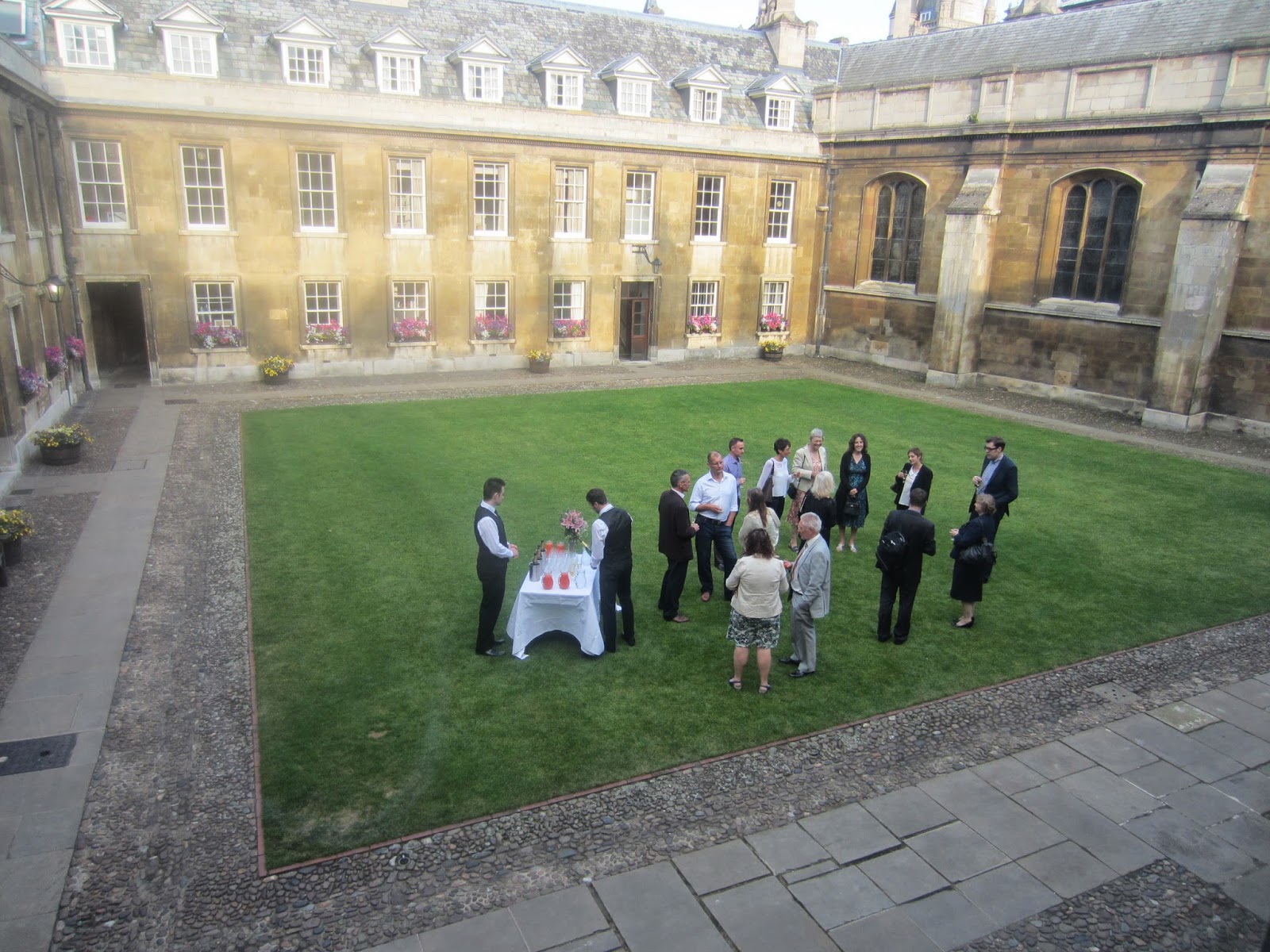
(Cambridge, June 30, 2014)
What a lovely place Cambridge is! My first time to present there. I spoke on how learning is changing in the main library. As noted, all my presentations in the UK and Finland (including the one at Cambridge) are posted. I had a lovely day hanging out with my friends Jim Hensman of Serious Gaming Center in Coventry and Cambridge Professor Brian J. Ford.
(King's College, July 1, 2014)
(Lunch in South Kensington, London with Alice Oven and Victoria Pavry from Epigeum, which is "Transforming Higher Education Through Exceptional Online Learning." Epigeum is developing some highly interesting and interactive faculty training programs. Alice is soon stepping back into a role at Imperial College Press.)
(Lunch at the University of Oxford, July 3, 2014 with my friends Dr. Dongping Zheng from the University of Hawaii (who was a research fellow at Oxford that week) and Dr. Chris Davies from the University of Oxford, Department of Education. Chris arranged for me to speak at Oxford a couple of times in the past. This time I had a Q&A session with his students. Dongping just got promotion and tenure and is now an associate professor.)
Chris has some extremely bright students who asked me many difficult questions about my research.
(University of South Wales (formerly the University of Glamorgan) July 4, 2014)
Is it time for you to add some TEC-VARIETY? Perhaps. Please let Elaine Khoo or I know if you do. You might give me a Reader Reaction or perhaps you will read them or the various book endorsements received so far. Not convinced yet? Perhaps you should read this overview article for Education Magazine or the short blog post that I did for Cengage last year before my presentation at SXSWedu explaining the evolution of this book. It has been a long and quite interesting process.
Enjoy. And do share the free e-book! Oh, I should note that the University of Waikato will have a book launching event on their campus on July 31st. They have already fashioned a book homepage.
Labels: Adding some TEC-VARIETY, Amazon CreateSpace, e-book, Ed Media, Elaine Khoo, Finland, MOOCs, online motivation, open education, R2D2, retention, self-publishing, TEC-VARIETY, UK, University of Waikato |
|
|
|
|
|
|