|
|
COL is "Keeping Doors Open"...and the world is very thankful! |
| Wednesday, March 25, 2020 |
I got an email yesterday from my friend Sanjaya Mishra from the Commonwealth of Learning (COL) with tons of wonderful vetted online resources across educational sectors.
It open with the following:
"With an increasing number of states, provinces and even whole countries
closing institutions of learning as a response to the COVID-19 pandemic,
over 80% of the world’s students are not attending school (UNESCO, 2020). COL stands ready to share its expertise and resources to enable stakeholders to keep the doors of learning open for all."
COL is exactly the type of organization that is geared up to help the world.
See COL’s statement on COVID-19. https://www.col.org/news/press-releases/keeping-doors-learning-open-covid-19
"With an increasing number of states, provinces and even whole countries
closing institutions of learning as a response to the COVID-19 pandemic,
363 million learners worldwide are being impacted (UNESCO, 2020)."
363 million learners! Look at the history:
"Since its establishment in 1987, COL has supported governments and
educational institutions in the Commonwealth to establish robust
distance teaching institutions and build competencies for quality online
learning practices. Over the years, it has created many resources,
including courses, policy briefs, how-to toolkits, as well as guidelines
on online learning and related areas that are downloadable for use by
policymakers, teachers and researchers around the globe."
And they further say:
"In these unprecedented times, ODL can support learning in the non-formal
and informal sectors, as well as the formal education sector. Below is a
curated list of resources for policymakers, school and college
administrators, teachers, parents and learners that will assist with
student learning during the closure of educational institutions. Most of
these are available as open educational resources with different
licenses. The specific license conditions for reuse and remix are
contained in the links."
I looked and I said WOW!
It has links to:
Take a look and you too can say WOW!
Thanks so much Sanjaya and COL! The COL specializes is OER resources evaluation, aggregation, and dissemination; especially for teacher training around the world. They are a world-class organization. A picture with Sanjaya Mishra (left side) and Santosh Panda (right) at the PCF9 conference in Edinburgh, Scotland in Septemer.
Labels: COL, Commonwealth of Learning, COVID-19, OER, open and distance learning, Open educational resources |
|
|
|
|
|
Indiana University (IU) continues to be an eText leader! (free book anyone?) |
| Thursday, April 26, 2018 |
My Indiana University (IU) colleagues, Dr. Brad Wheeler and Dr. Stacy Morrone, held a timely and brilliant Webinar on Tuesday afternoon April 24 with Pearson and the Chronicle of HE on the eTextbook initiative at IU. (If interested, Click
here to sign in and access the recording).
During the event, they announced and launched a free open access book from Creative Commons on the topic from IU: “eTexts 101: A Practical Guide.” Want a copy? Just go here to Download or read online. If interested, below is the Table of Contents (TOC). Have a look.
Brad Wheeler just noted to me that with the launching of this book, IU has "opened the door and put the model [that IU is using] in place as another option" for IU faculty to have "another option for their course materials, and they are choosing it with greater frequency." Perhaps other institutions will follow it as well or tweak it for their own purposes. As a new and emerging area, there is much need for such models in the eTextbook field. People need to understand what is required to undertake such an initiative, what is possible with book publishers, how to negotiate contracts, the potential benefits, the road ahead (i.e., the timeline or multiple timelines), and so on.
Here at IU, it is a proven success story. As shown below, there are 9 times as many eText adoptions in terms of course sections and 7-8 times as many student users of eTexts at IU now then there was just 5 short years ago. Faculty members are also jumping on board with 6-7 times as many unique faculty in 2017 compared to 2012. Wow...that is some growth.
The savings are
literally amazing! See below for a depiction of the cost savings for IU students from 2012-2017.
Oh...how about a quick snapshot on eTexts at IU for 2017-2018. Brad Wheeler just sent me the image below to share. It is very telling. As he notes, IU faculty have driven this overwhelmingly positive response. IU faculty have been quite progressive when it comes to adapting technology for their instruction for a long time. When I got here in August of 1992, there were many interesting learning technology-related initiatives taking place.
Write me an email if
you want a PDF of their talk slides or the book (or see the link above).
As shown by the data above, IU
continues to lead the academic technology world. Last week Wednesday April 18th may have been IU Day. But when it comes to eTexts, every day is IU day! Go IU!
Labels: eText adoptions, eText experiences, eText savings, eTextbooks, eTexts 101: A Practical Guide, Indiana University, Open educational resources, textbook adoptions |
|
|
|
|
|
Open-access articles on the "Digital Campus" about open access |
| Tuesday, May 01, 2012 |
Are you interested in open education and alternative learning routes? Are you concerned about the regimentation of schools and academic programs? I know that I am. I always have been. I never really liked traditional schools and schooling. Fortunately, emerging learning technologies often provide options for learning. Audiotapes, TV, satellite, radio, CDs, etc. As many people know by now, TV and correspondence courses saved my sanity back when I was a highly bored corporate controller and CPA back in the early to mid 1980s. And today the Web is saving countless lives.
However, it is getting harder and harder to keep up with the news in learning technology and open education. I am not sure how anyone can be an expert in online learning or open education. What is interesting is that today this is a hot topic and front page news. Back in 1984, it was not. And now with venture capital pouring in, this space will be expanding even more. More open access articles will be published about open access. And finance people (I used to be one) and marketing people will begin to take center stage. Is it, "exit stage right" for academics and researchers...? I think not. There is so much to research here. My team is asking many open educational resource (OER) questions.
But each day there is something pressing to read from Education Week, the NY Times, the Washington Post, the USA Today, Time, eSchool News or eCampus News, Chief Learning Officer, Wired, or the Chronicle of Higher Education. Well, now there is a special issue in the Chronicle of Higher Education on the Digital Campus. This issue came out online on April 29, 2012 and the paper edition was in my mailbox this afternoon. The articles within it are definitely emphasizing this wave of open education. The world is open for learning as we all know by now. Don't agree? Read on. And on and on and on. There are so many examples today of how one can learn online in extreme and not so extreme ways. As the previous link indicates, my research is now in extreme learning.
There is one article by Katherine Mangan in this special edition that immediately caught my attention. It gives anyone reading it a sense of wonder about where, when, and how learning can occur. The title is "Open Education's Wide World of Possibilities" (Note: you may need a password for this article now. Earlier today, you did not. If you cannot access it from the link above, try here (Note: this is an alternative link from the Chronicle of HE) or try here instead (for a blogger post of the article)). Three sources for this article? Well, actually, I found about 20. This is just another example of the open learning world.
When reading this intriguing article, you will "discover" that learning can now take place from Tibet while herding yaks, from the northern tip of Canada while collecting scientific data, from soup kitchens and orphanages in Mongolia, and so on. Dentists in rural parts of Afghanistan are upgrading their skills from shared online videos from the School of Dentistry at the University of Michigan. College kids are passing classes in which they were initially "floundering" after finding open educational resources which helped them learn. Former accountants (like me) are teaching science and winning awards after "plowing through" online lectures and Khan Academy materials. MITx, Udacity, iTunes U, Peer 2 Peer University, Saylor.org, and many other resources are springing up to change the learning possibilities for the people of this planet.
These are exciting times indeed. How do the different open-access courses compare? What do you get? Videotaped lectures? Guest experts? Access to the instructor? Online study groups to learn with?Asynchronous discussions? Syllabi? Audio files? You can read more about what is offered in different free online courses in a chart comparing their content. That article is called: Open-Access Courses: How They Compare.
What exciting times these are! I wrote about some of this in a newsletter piece for the Association for Learning Technology (ALT) Online Newsletter back in October 2009 (The Wide Open Learning World: Sea, Land, and Ice Views) as well as in my World is Open book. Today anyone can learn anything from anyone else at any time.
You can read about John Boyer's fascinating class at Virginia Tech with more than 2,600 students. The course is in geography and is called "World Regions." Read this one and you will hear about a professor who is truly loved by his students. He goes all out to help his students learn. And learn they do. Boyer brings in guest experts from around the world. And he uses many types of free and open access technologies like Ustream, Facebook, Twitter, shared online videos, and Skype to help them learn. In effect, Boyer is a role model for this open educational world that we are now in. The article is called "Supersizing the College Classroom: How One Instructor Teaches 2,670 Students."
Speaking of which, my MOOC for Blackboard that starts later today at 4 pm EST (and is every Wednesday in the month of May at that time) now has over 3,200 people in it. Wow. Hope you can join in. The course will remain open for registration during the month of May. No worries if you sign up late.
Here are a couple of other articles in the special issue (or from that day) that might be of interest:
1. The Imperfect Art of Designing Online Courses, The Chronicle of Higher Education, Dan Berrett, April 29, 2012.
2. Social Networks for Academics Proliferate, Despite Some Doubts, Chronicle of Higher Education, Katherine Mangan, April 29, 2012.
There are many more articles in this special issue. That is enough for now. You can find them from the first link in this blog post.
When you are done browsing and reading them, you might consider signing up for the MOOC. Hope to see some of you in the Blackboard/CourseSites MOOC or beyond. We will try to address all this confusion with a couple of simple frameworks or models for making sense of it. That is the hope anyway. And perhaps the ideas discussed or presented in it can help a life or 2 (or more). Fingers crossedLabels: Blackboard, Blackboard MOOC, CourseSites, MOOC, open courseware, open education, Open educational resources, open-access articles, the Chronicle of Higher Education |
|
|
|
|
|
Meeting Arnie Duncan at SXSWedu in Austin while attending the SITE Conference |
| Thursday, March 08, 2012 |


Below are some unedited notes from Arnie Duncan's special talk at the SWSEedu conference today. I am hopping on a plane here in Austin and will edit and refine them if and when I get home (we are delayed in Austin (1 hour). I later was delayed another 5-6 hours in Memphis and got home at 4 am).
I was at the SITE conference in Austin this week. In particular, I was at SITE to run a special 2 hour symposium on Tuesday March 6th with Dr. Mimi Miyoung Lee from the University of Houston. The title of the symposium was: "Emerging Technologies for Informal Learning: Transforming Traditional Education from the Inside and the Outside." Hour #1 was on "Mobile Learning, Gaming, and Digital Books" and Hour #2 was on "Nontraditional, Adventure, and Extreme Learning." I spoke in the second part on my new research area of Extreme Learning. It went very well. My good friend, Paul Kim from Stanford and Seeds for Empowerment, gave an exceptionally great performance in Hour #1. So did everyone else.
Symposium on “Emerging Technologies for Informal Learning: Transforming Education from the Inside and the Outside”
SITE Symposium Presenters:
Hour #1: Mobile Learning, Gaming, and Digital Books , (Session Chair, Joan Hughes, University of Texas at Austin)
1. Scott Warren, University of North Texas.
2. Priya Nihalani and Michael Mayrath, GetYa Learn On (GYLO), LLC.
3. Paul Kim, Stanford University.
4. Ke Zhang, Wayne State University.
Hour #2: Nontraditional, Adventure, and Extreme Learning. (Session Chair, Paul Resta, University of Texas at Austin)
5. George Veletsianos (homepage), University of Texas at Austin and Brant Miller and Justin Hougham from the U of Idaho.
6. Curt Bonk and Justin Whiting Indiana University.
7. Ana-Paula Correia, Iowa State University.
8. Mimi Miyoung Lee, University of Houston, Discussant.
However, today (Thursday the 8th) I had to leave SITE in the morning since I had to take the place of Paul Resta from UT Austin at the SXSWedu conference. I was a panelist at a session on disruptive education (“Where is the Disruption: Panel of Experts Discuss.” After my talk, Jane McGonigal talked about gaming. Michael Mayrath from GYLO (Get Ya Learn On) invited me to be on the panel with him. Dr. Paul Resta from UT Austin was supposed to be on it but he had to help run the SITE conference (see pictures with Michael below).


And then we all went over to Arnie Duncan’s invited talk. Note are below.
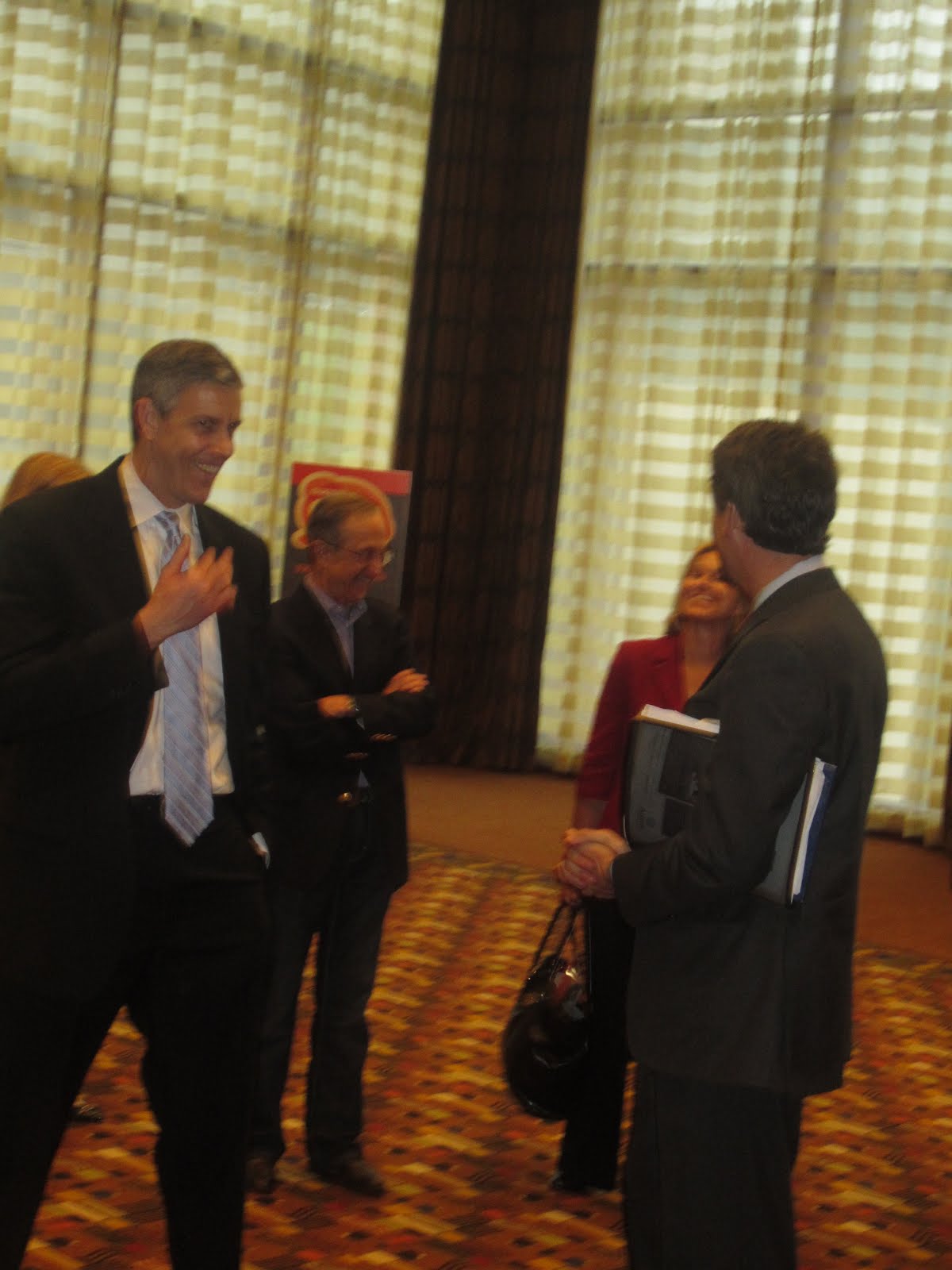
After the talk, Arnie Duncan went across the street to the Hilton. I got a couple of pictures of him on the way.


He went to a private room on the 2nd floor to meet with people from the Austin Chamber of Commerce. Thanks to a friend, I got to meet Arnie Duncan at this private meeting. Standing behind me was Karen Cator, a former Apple executive who is director of educational technology for the United States Department of Education. I had seen Karen at the NSF Cyberlearning Summit in DC back in January at National Geographic. Fortunately, she recognized me.
I guess I stuck out since I had a one day temporary badge (their badge printing machine was not working when I checked in). I also kinda stuck out since I was taking his picture as he spoke and I was not from the Chamber of Commerce in Austin. Still, before I knew it, I got to ask him a question about open education (I asked about the $2 billion OER initiative at the high school and community college levels that was announced back in June 2009). It was around that time that some folks standing behind me were wondering who I was (secret service?). Smile. Karen Cator recognized me and I got to stay. Arnie Duncan, in fact, answered the question--new developments are coming in the next week or two. A picture from the intimate session is below.
Though I did not realize it at the time, standing next to me was Geordi LaForge (i.e., actor LeVar Burton) from Star Trek Next Generation. He was also Kunta Kinte from Roots (back when he was around 20) and the host and executive producer of Reading Rainbow. Very cool. On the other side of me, were some venture capitalists and other high ranking Austin officials. In addition, I met a well known VP at PBS. His name is Rob Lippincott, Senior Vice President of Education for PBS. He was really interesting. Here is a picture with him and my friends Michael Mayrath and Priya Nihalani from GetYaLearnOn (GYLO). GYLO is pushing ahead in the digital book and mobile learning space.

Here are my quick unedited notes from Arnie Duncan's Keynote at the SXSWedu conference in Austin. I should point out that this conference had 3,000 people this year in just its 2nd year (Year #1 last year had 1,000 people). That is some huge growth.
= = = = = = = = = = = = = = = = = = = = = = = =
Arnie Duncan's Speech at SXSWedu:
These are my notes (the exact transcript from the U.S. Department of Education can be found at ED.gov from the U.S. Department of Education: The New Platform for Learning; March 8, 2012).
Per Arnie Duncan: I should tell you that my wife and kids laughed when he got asked to speak at a technology conference. I am known as a dinosaur in terms of technology (at least in the past I was). But, at least to some degree, that has changed. I have had to change. No doubt about it, technology is a game changer in education.
Technology offers many things including greater personalization of learning. It also eliminates geographic barriers to knowledge. It replaces the bubble test. Technology is the new platform for learning. And technology competency is not an option any longer. Progressive educators are using technology in bold ways to change educational possibilities. Take, for example, Marks Edwards, Superintendent, from Mooresville, South Carolina (as an aside, see this NY Times article; it may require a password; here is a PBS news story and interview as well as video that does not require a password--very interesting).
Duncan continues...He gave students in grades 4-12 a laptop. It increased readings, retention, and math test scores. Mark’s teachers are roaming conductors. The teachers (and the technology) can challenge student 1 on 1. Cost not prohibitive. It only costs a dollar or so a day to do this in terms of their technology costs per students. They are not spending more than other districts; instead, they are spending smarter.
Here are some more successes. The Open High School in Utah--they are adopting all digital content and no physical textbooks which are quite expensive. The Florida Virtual School—they have close to 100,000 students attending virtual schools. Then there is Idaho which is making huge strides in offering online classes to all students (see Idaho Digital Learning--as an aside, I spoke at their online conference last summer). I should also mention Joplin, Missouri (see March 7, 2012 article in Edudemic); this includes $500,000 donated by the UAE by the way. After the tornado tradegy, students came back to school and got their own laptop. Finally, at the School of One in NY which I visited, all students have technology and are engaged in their own learning.
In terms of initiatives at the federal level, in 2010, we issued a comprehensive technology plan (National Education Technology Plan 2010; more info here). Some 47 states have adopted. With this plan, there is hope to tailor information to student needs as well as parents and teachers. Using technology, students (and teachers) can become more productive. I need to mention Karen Cator who is on my team in the Office of Educational Technology at the U.S. Department of Education. Karen can you stand up. Please give her a round of applause.
The list of panels at this conference is evidence of change—-thhere are sessions on interactive art, game design for STEM, etc. I see one session on "Supersizing the classroom" with some 3,000 students and beyond. I do not recommend such supersizing in most educational settings. But it can definitely change college introductory courses. Clearly, there is tremendous creativity here. While education moves slowly, the world is changing.
There is much potential with these changes. Keep in mind that K-12 ed is a $650 billion industry. And higher education is over a 1 trillion industry. As a result, there are loads of decisions about what and how to teach that we will face in the coming years.
Khan Academy is offering hope for kids and changing how they learn. Sal Khan is creating opportunities for kids to learn when and where they want.
In addition to the Khan Academy, there are many great partnerships emerging that are pushing states to be more friendly in the use of technology in education. Former Governors, Bob Wise from West Virginia and Jeb Bush from Florida, involved in that.
The Obama Administration has done much including $4 billion in Race to the Top monies. In addition, much attention is now placed on STEM (Science, Technology, Engineering, and Mathematics). There is also the Recovery Act and a push to increase broadband access. Of course, we are trying to close the digital divide. Targeting low income opportunities to connect to the Web.
In higher education, we have done much. For instance, Pell Grants have gone from 6 million to 9 million in 3 years. And, as we all know, community colleges are bursting at the seams with more and more students. Some community colleges have 12,000 students on their campus in a single day (I think that is the number he said).
All told, educational technology can provide educational equity and level the playing field. It definitely gives a boost to students with disabilities. Technology helps teacher leaders in tough schools. We must continue to de-privatize education (I really do not know what he meant by that). (A pic is below).

Technology can individualize teacher training programs. Technology can help in many aspects of education. Assessment is behind everything—but education lags behind in this area (i.e., assessment). Technology must make learning interactive, effective, engaging, and fun. More that the classroom mimic the real world, the more engaged kids will be in learning.
Superintendent Edwards talks about the engagement and creativity—with one click you can go beyond your classroom and community. It challenges kids to think critically. College kids can access open access books and articles to reduce costs. All the curricula that they are trying to create are open source and open access.
Sal Khan has 2,700 video and 190 million downloads since he started and it is free. MIT, Yake, Tufts, and others are doing this. China, India, Brazil, etc. American entrepreneurs need to lead the change. I am here today to plead with you to support technology to change education.
We must educate our way to a better economy. We need both teachers AND computers. Great technology can transform the lives of many people. Next week, much cutting edge music will be here in Austin. People coming will have cell phones, iPads, mobile devices, etc., and will share their work in countless ways. People are sharing and recording in countless ways. So many ways that the sharing of music happens today. Still technology cannot write “Born to Run” or “Let it Be.” Technology is a critical tool to learn and to teach.
We must educate our way to a stronger economy. Technology tells us so much about ourselves and others. Yet, we come to Austin since there is no substitute for FTF interaction. The future of American education includes access to technology. But a great teacher is still needed to inspire us and help us. Teachers take your products from the drawing board to the classroom. Our kids are waiting for it and wanting it to happen now.
Thank you so much and I am happy to take your questions.
(Note: The above text is not a direct quote or perfect transcript as I added my interpretation and transitions as well as linkages to associated Web resources and articles. Nevertheless, it is pretty close to what he actually stated.
Again, if you want the exact transcript, see ED.gov from the U.S. Department of Education: The New Platform for Learning; March 8, 2012.)
Question and Answer from the audience at SXSWedu...
Person #1. What about college costs: Working on ways to reduce costs.
Per Arnie Duncan: This past year, 40 states reduced funding to higher education. Our priorities are out of whack. Universities must try to maintain costs or reduce costs. In budget proposal, there is $5 billion of incentivize states. There are real challenges on the higher education side. We need a college scorecard—for actual costs. Both states and universities must step up.
Person 2. What is the role of for-profit gaming companies and video companies in education?
Per Arnie Duncan: I believe that both for-profit and non profit organizations are very important; especially for STEM. (Note: this was a very weak answer. There were no creative ideas offered about how the for-profit industry could work with different educational sectors...I wanted to hear more about potential joint research and development, awards and recognitions, incentives, partnerships, proposals, etc. Nothing. Just, ya, "I believe that both are important.")
Person #3. Teacher satisfaction and morale is low. What to do?
Per Arnie Duncan: The Recovery Act saved hundreds of thousands of jobs. The status of the teaching profession has been beaten down. Technology cannot do it by itself. Teachers are way underpaid. I think that we need to double the salary. We lose too much talent. As a country, our values must change. The vast majority of teachers are high performing. In Korea, they treat teachers as Nation Builders. That is how they are viewed in Korea. I would like teachers in the USA to be treated more like that.
Person #4. In terms of building connectivity, in all of your travels to other ministries and departments outside of the USA, what would you like to see here?
Per Arnie Duncan: The jobs go to where the knowledge workers are. We have the 2nd education summit coming up. In Singapore, 90 percent of people are not allowed into teaching. They screen out the lower performers. And they compensate teachers better. There is a high bar to entry. More support and respect. And better compensation. Such an approach will change the country here. Talent matters. We need to attract great talent. That talent will transform this country.
Person #5. What about the “Learn to Earn” act. Tell me about it…?
Per Arnie Duncan: I am a huge fan of entrepreneurship. Not just theoretical and book learning. We must encourage it. Gives relevancy in the community. (Again, not much of an answer here. So, for more on the Learn and Earn Act, see this article in a Policy Forum Blog. This blog post from Lynn Miller Associates is even better; apparently, the goal is "implement high quality entrepreneurship programs in communities all across the country.")
Person #6. I am a public high school teacher in Texas. Thanks for your words of wisdom. I would like to know how you can account for the cognitive dissonance between No Child Left Behind and what kids need in the real world.
Per Arnie Duncan: Are you from Texas? I am going to meet with your governor (Rick Perry of Texas) to talk to him about a waiver for NCLB. There are 11 states with such a waiver already. (Some laughs, snickers, and applause.)
Person #7. Mass communication student who works in the non-profit sector. I no longer have subsidized loans. I used to have them but then I was suddenly cut off. What gives? I was given no notice. What can I do?
Per Arnie Duncan: I would like help you. See my people here and ask them to check into it...and I assure you that they will. (Again, more snickers and faint applause.)
= = = = = = = = = = = = = = = = = = = = = = = =
It was great to meet him:

The end. More soon when I land. Well, my plane did not land until 7 hours after it was supposed to. I got home to Bloomington at 4 am and had to drive up the following day to keynote the Midwest Scholars Conference in Indianapolis which was run by Indiana Wesleyan University.
Ok, I have updated this blog post 3 days later (Sunday March 11, 2012). Hope it is improved. Time for a run.Labels: Arnie Duncan, Open educational resources, SITE, SXSWedu |
|
|
|
|
|
|