|
|
"MOOCs and Open Education" Book and Special Issue...Now Published...AND also Published! |
| Wednesday, July 08, 2015 |
Special Side Note: After the blog post below was made, a website was created for both the book and special issue. That website is MOOCsbook.com or http://moocsbook.com/. Please click that link for more information.
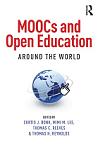
Some Really Big (i.e., "Massive") News: Both the MOOCs and Open Education Around the World book is now published by Routledge. It came out in late June. The book has around 64 contributors from 13 countries. They wrote some 29 chapters, 2 forewords, and 1 preface or 32 total pieces.
More Massive News: Also published is the special issue of the International Journal on E-Learning that is also on MOOCs and Open Education (by AACE). It came out digitally July 1 and soon in print. The Special has 8 articles. These are totally different articles from the book.
When combined, you will find 40 articles that my team, Dr. Mimi Lee from the University of Houston, Dr. Tom Reeves from The University of Georgia, and Dr. Tom Reynolds from National University, and I (Curt Bonk from Indiana University) have been working on for 1-2 years. What's a MOOC you say? A MOOC is a "massive open online course." What's open education you add? Well, read the free preface to the book (see link below).
Tom, Tom, Mimi, and I are delighted that these two projects are now completed and we can do other things. These projects have consumed much of our free time for longer than we care to admit. The book and special issue projects both got their start at the International E-Learn Conference in Las Vegas in October 2013 (actually 6-8 months prior). In effect, we have been working on these two little babies for nearly two years, if not longer. Yikes! Here is some ordering information and some free stuff. Below that are the book covers. But remember, my homepage has links to everything.
Special Issue: IJEL 14(3), July 2015, or see EdITLib from AACE. (Amazon link coming)
Book: Homepage (Routledge); Amazon (Kindle (Approximately $35), Softcover (Around $37); Hardcover ($132));
Free: Shareable Preface and Chapter Abstracts (if you cannot find it, try http://publicationshare.com/moocsbook/).
Book Reference:
Bonk, C. J., Lee. M. M., Reeves, T. C., & Reynolds, T. H. (Eds). (2015). MOOCs and Open Education Around the World. NY: Routledge.
Special Issue Reference:
Lee, M. M., Bonk, C. J., Reynolds, T. H., & Reeves, T. C. (Eds.) (2015). Special Issue: MOOCs and Open Education. International Journal on E-Learning, 14(3), 261-400.
I hope you enjoy the book and special issue. Reviews, suggestions, feedback, and so on are always welcome. Welcome to the world of MOOCs and Open Education! Remember the free book preface and chapter abstracts and contributor information. The world is now "open" for you as well as for me.
Special Side Note Reminder: After the blog post below was made, a website was created for both the book and special issue. That website is MOOCsbook.com or http://moocsbook.com/.Labels: AACE, E-Learn Conference, e-learning, IJEL, International Journal on E-Learning, massive open online courses, MOOCs, OCW, OER, open education, Routledge |
|
|
|
|
|
An Interview with Dr. Paul Kim, E-Learn 2013 Keynote Speaker, Preconference Symposium on “MOOCs and Open Education |
| Friday, October 11, 2013 |
An
Interview with Dr. Paul Kim, E-Learn 2013 Keynote Speaker, Preconference
Symposium on “MOOCs and Open Education
The E-Learn 2013 conference in Las
Vegas is coming up in a little over a week. I am helping run the preconference
on MOOCs and Open
Education on October 21 st. Paul Kim from
Stanford is the opening keynote. I had a chance to ask Paul a few questions
prior to his keynote. His responses are below.
Abstract:
"MOOC” is a fairly recent term. It is also a “Learning For All” movement
currently stimulating active debates in the education space around the world.
MOOC simply denotes a Massive Open Online Course, but in the larger context, it
may be a catalyst to reimagine higher education. Whether MOOCs are part of a
global open education initiative or a for-profit education model, today there
is certainly growing R&D interest, as well as entrepreneurial attention.
There is, however, substantial criticism and typical bystander skepticism,
mostly arising from reports describing the quite unexciting completion rates of
many MOOCs. Acknowledging the abundant misunderstandings around MOOCs and the
vague institutional goals from early-adopter universities, an argument can be
made that the current structures of MOOCs today are not sustainable. In this
session, The Anatomy of a MOOC, the non-profit and for-profit models will be
viewed, compared, and presented through the lens of sustainability.
Topic #1:
Some General Questions about Your MOOC:
Curt Bonk:
What was the title of your most recent MOOC?
Paul Kim: "Designing a new learning
environment"
Curt: When
did you teach it?
Paul: Fall 2012
Curt: How
many enrolled?
Paul: Close to 20,000.
Curt: Do
you have any sense of how many “completed” it?
Paul: Around 1,000.
Curt: What
was the platform?
Curt: What
was the URL?
Topic #2:
Beyond Wildest Dreams
Curt: What
was the most exciting thing that happened during your MOOC?
Paul: Students from 170 countries.
Curt: Something
outside your expectations…
Paul: The
power of social network channels.
Topic #3: Specific
Learner Success Story:
Curt: Do
you have an unusual or interesting MOOC success story of a particular person
who enrolled in your massive course that you might share?
Paul: Middle
school student working with phd students and leading as a team leader. He
graduated with distinction which requires a lot of respect from peer
evaluation.
Topic #4: Disappointment(s):
Curt: What
was the most disappointing aspect of your MOOC?
Paul: Not
as open as I hoped.
Curt: What
fell short of expectations?
Paul: Institutional
support.
Topic #5:
Pedagogical Success and Failure:
Curt: Can
you briefly describe one unique pedagogical task or idea that you attempted
during your MOOC that worked well and one that did not work so well?
Paul: Team project and peer evaluation
worked well. Team formation process needs more innovation.
Curt: Do
you have advice for others who might try these approaches?
Paul: Don't just move stuff from LMS to
mooc platform. You need to really leverage your global classroom environment.
Topic #6: Potential
for Research:
Curt: Looking
back on your MOOC, what research might be done in this area that you have yet
to see?
Paul: Features that help low self-regulators
to develop self-regulation strategies.
Curt: What
questions are not being asked?
Paul: Why students need to learn how to
learn in the 21st century.
Topic #7: Culturally
Relevant:
Curt: How
did you try to make the content of your MOOC or other open educational
resources that you have designed relevant to people from different cultures or
backgrounds?
Paul: Discussed cases from Africa, Asia,
Latin America, etc.
Curt: What
might others do in this regard?
Paul: Involve cases from all continents if
possible.
Topic #8:
Instructor Metaphor:
Curt: In
describing the role of a MOOC instructor, I like to use “C” words like curator,
concierge, cultivator, counselor, consultant, orchestra conductor, etc.. Some
might say “cat herder” or “credit manager.” How might you describe your role in
your MOOC? What metaphor might you use? Instructor as ___? Why so?
Paul: Completely inspired to inspire
others.
Topic #9:
Learner Completion:
Curt: Critics
of MOOCs seem determined that there are huge problems related to learner
motivation and retention. What are your views about learner completion rates?
Paul: This needs to be interpreted
differently depending on different student needs.
Curt: How
should we measure student success and failure?
Paul: We should ask each student what they
are doing after a MOOC.
Topic #10: Surprising
or Unusual Theme or Issue:
Curt: What
is one theme, finding, idea, concern, or issue that you will hit upon during
your preconference symposium keynote at e-Learn that may surprise some people?
Why?
Paul: Passion is viral in a MOOC.
Learning is
awakening, not memorizing.
Topic #11. Latest Idea:
Curt: What
is the newest idea or concept that will enter into your talk at E-Learn that
you may not have discussed previously?
Paul: Sustainability is more important
than mobility in educational development work.
Curt: What
excites you about it?
Paul: I finally got some ideas about it!
Topic #12. What’s Coming Next:
Curt: Do
you have any new ventures, courses, research projects, or ideas related to
MOOCs or open education on your radar or that may happen in the near future? If
so, what are they?
Paul: Build and implement a new learning
environment, leading to creating and expanding a new workforce development
ecosystem.
Labels: AACE, E-Learn, E-Learn 2013, interview, MOOCs, open education, Paul Kim, Preconference Symposium, Stanford University, sustainability |
|
|
|
|
|
Moving Clocks from 2008 to 2013 for MOOCs and Open Ed: It's E-Learn Las Vegas Once Again |
| Friday, August 30, 2013 |
Reflecting Back Five Years…
The 2008 E-Learn Preconference Symposium
on E-Learning in Asia:
Five years ago, my colleagues (Tom
Reynolds from National University, Mimi Lee from the University of Houston, and
I coordinated a preconference symposium on “E-learning n Asia” in
Las Vegas during the E-Learn 2008 conference. After a special invitation from
Gary Marks, Founder and Director of AACE,
we also were conference program co-chairs that year. AACE runs many conferences
including Ed Media, E-Learn, SITE, Global TIME, and Global LEARN. And E-Learn is one of
the best. There are typically around 800 to 1,000 or more people who attend
from around the world. And when it is on the west coast or in Hawaii, many
participants fly in from Australasia. And that is exactly where many of my
friends live.
Though it was a ton of work to help
coordinate entire conference as well as the symposium before it started, we had
a great time during the preconference symposium. Even better, our old friend,
Dr. Tom Reeves from the University of Georgia, popped in and ended up helping
us out in a big way (if interested in the topics and participants that day, see
this old blog post and 2008
preconference symposium program—you will notice many superfantastic
participants that we had). Tom Reeves ended up giving a splendid recap
reflection on what he had heard that day. It was highly insightful and humorous
at the same time. So crisp were his remarks, that we invited him to help with
the special issue of a journal that came out of that session (see below).
As indicated, during our 2008 symposium
during E-Learn in Las Vegas, we had well known e-learning researchers from many
countries in Asia fly in to give their overview of the state of e-learning in
their respective countries. We had top e-learning scholars from China, Korea,
Japan, Taiwan, India, Singapore, Malaysia, the Philippines, and someone from
Australia who was researching e-learning in Turkey as well as other countries.
We all bonded together and remain best friends and close colleagues. In fact, I
will visit many of them when in Japan next month (September 16 to October 1)
and in Taiwan 2 months later (November 7 to the 20th I think). And some are
coming to E-Learn in
Las Vegas in October.
In addition to the symposium back in
2008, there was a special issue of a journal as well as a print-on-demand book (“A Special Path through Asia
E-Learning” that sprang from that glorious day. The citation is below (Mimi Lee
wrote the introduction to the articles, while Tom Reeves wrote the closing
reflection). You can read their pieces in the journal issue or in the book which costs just $15.
Below is a picture of most of the people
who contributed to the first symposium back in October 2008. This picture was
taken right after the final presentation that afternoon. Needless to say, we
had a very fun and informative time.
After a quick freshening up, we then went
to dinner and then a show in Las Vegas (Le Rev) after the symposium ended. As I
said, it was truly a marvelous day. And many great friendships were formed.
Global Learn. We had so much
fun that after the 2008 event, the four of us (Tom, Tom, Mimi, and I) along
with most of the symposium participants helped create a new conference for AACE
called “Global Learn.” Global Learn had live events in May 2010 in Penang,
Malaysia and in March 2011 in Melbourne, Australia. Each was exceptional.
Penang was certainly a great kick-off! Since then, it has gone virtual. For
instance, there was a virtual Global Learn this past year mainly focused on
Europe and North America. It may go back to a live event in the future. Can you
say Singapore anyone? Well, perhaps.
The 2013 E-Learn Preconference Symposium
on MOOCs and Open Education (Oct 21):
Fast forward five years and the four of
us are hard at work organizing another such event in the exact same city for
very same conference. Very exciting! Only this time it is on massive open
online courses (MOOCs) and open education (see symposium
details). The event will take place on Monday October 21 at the Paris and Bally Convention Center as part of the E-Learn 2013 Conference
with an optional hiking and reflection trip the afternoon before (Sunday the 20th)
in Red Rock Canyon. However, instead of the Riviera like last
time, this conference is in the Paris Las Vegas and Bally's Las Vegas (you will find me in the Paris). Both are
much better venues than the Riviera and vastly improved locations in the middle
of the strip. As mentioned, we have great guest speakers liked up (see below)
as well as an excellent panel of international experts. In addition, there are
thematically designed breakout groups.
I hope to see you at the 2013
preconference symposium for E-Learn on MOOCs and Open Education. We
have an opening keynote from Paul Kim from Stanford to start the day. He will
discuss “MOOCs through the Lens of Sustainability.” And we
will have a keynote from George Siemens, the de facto co-inventor of the MOOC,
to end the day. His talk, “MOOCs:
Where Next?” will get us to think about the future of higher
education and education in general. We are extremely fortunate to have these
two amazing people help kick-off and end the day. Read their bios! Paul Kim has
created many interesting projects including the pocket school project (i.e.,
the teacher is in your pocket as a mobile device) which I discuss in my World is Open book. And
George Siemens helped create a new learning theory called “Connectivism.” In
addition, he has helped lead the charge for better learning analytics from
online courses. These are two of the most prolific and influential people in
the fields of educational technology and e-learning that I know.
But wait, there is more…there is always
more! After lunch, there will be an international panel address topics like
attrition, accreditation, and assessment of MOOCs and open education. We will
also have thematic breakout groups in the morning as well as the afternoon that
you can participate in. And we will end the day with a social. Of course, there
will be much discussion all day as well as much reflection, sharing, thinking,
interaction, and new connections.
Read on for more details, read on below.
For those new to this topic, MOOCs = massive open online courses. Write
to me if you have questions (cjbonk at Indiana dot edu). See you in October. To
see if you are ready (i.e., MOOC ready), there is a 10 item checklist below.
Let me know how well you did when I see you October 21, 2013.

|
|
|
MOOCs and Open Education
Around the World
Las Vegas, NV: October 21, 2013, 8:00 AM - 5:00 PM
Social Reception to follow: 5:15 - 6:15 PM
|
|
|
|
|
|
|
|
|
|
|
|
|
|
|
|
|
|
|
|
Are you MOOC ready? If not
sure, perhaps you should review this 10 item checklist
below:
 Are you interested in MOOCs?
 How about Open
Education?
Would you like to hear the inventor of the first
MOOC, George Siemens, predict where he thinks we are going next?
 Might you want to know what happened when Stanford
Professor Paul Kim taught a MOOC on "Designing a New
Learning Environment" to over 20,000 people enrolled from
around the world?
 Perhaps you want to listen to an international panel
speak on pressing issues of attrition, accreditation, and
assessment in MOOCs and Open Education. Do you have questions for
them?
Are you interested in the challenges, successes and
motivational intents of those enrolled in MOOCs?
How about the challenges facing organizations and
entire countries attempting to implement MOOCs?
 Or maybe you have a specific issue or set of issues
that you wish to discuss with others and get their insights and
feedback. What say you?
 Might you want to engage in a couple of hands-on,
small group sessions related to MOOCs and Open Education?
Do you like to reflect, discuss, think, converse,
and socialize?
If so, have we got a
marvelous day for you! Welcome to the special
"Preconference Symposium on MOOCs and
Open Education
Around the World."
Cost: $165 (includes beverage breaks, lunch, and reception)
Special Registration Note: Please also consider participating in the E-Learn
2013 conference, beginning the next day. It is NOT necessary to
register for E-Learn in order to attend the Symposium. Viva Las
Vegas!
Organizing Committee and
Symposium Facilitators
Curt Bonk, Indiana Univ.; Mimi Lee, Univ. of
Houston; Tom Reeves, Univ. of Georgia; Tom Reynolds,
National Univ.
For more Symposium details,
see:
|
|
|
|
|
Final Call
for Papers
Proposals Due:
August 30,
2013
|
Register
Early and Save!
Early Registration:
September 13,
2013 
|
Las Vegas
and Hotel Details
Hotel Reservations:
September 19,
2013

|
|
AACE
P.O. Box 1545 Chesapeake, VA, USA 23327-1545
E-mail: info@aace.org | Phone:
757-366-5606
|
|
|
|
|
|
|
|
|
|
|
|
|
|
|
|
|
|
|
|
|
|
Labels: AACE, E-Learn, E-learning in Asia, George Siemens, Global Learn, Las Vegas, MOOCs, open education, Paul Kim, reflections |
|
|
|
|
|
|