|
|
Finding my inner public radio voice in this sometimes scary age of scrolling screens |
| Friday, June 02, 2017 |
Do you like radio? Me too! I love a chance to be on the radio. I remember being on the radio in Adelaide, Australia back in November 2012 and listening to it later and saying to myself, "Wow, they really can do wonders with one's voice." Have a listen to this 7 minute show with Angus
Randall on "Learnin’ How to Teach? I have been on dozens of radio shows over the years, including NPR in San Diego, LA, Wisconsin Public Radio in Madison (my home state), Chicago (on Navy Pier), and Indiana (here in Bloomington) as well as programs from the Canadian Broadcasting Corp, The USA Radio Network, Tech Tech, Voice America Women's Network, and many more. Each time I come away with new ideas and perspectives and a sense of accomplishment, It is such a highly enjoyable experience (we just won't talk about my experiences on television). Here's an old pic from Chicago Public Radio on Navy Per and one from WUWM Milwaukee Public Radio; both are from October 15, 2009 when I was on a promo tour of my World Is Open book. I think I did 4 radio shows that day (Racine, Wisconsin was also included). What fun! But that was back when I had a publicist for my book, The World is Open.
However, it has been a while since I was last on a live radio show a little over a year ago (on April 18, 2016 to be exact) when I was in Hamilton, New Zealand for a distance learning conference. I was on Radio New Zealand with Jessi Mulligan for an 11 minute reflection on emerging technologies. I should also note that a month ago, my friend Patrick O'Shea interviewed me for an upcoming Immersive Learning Research Network (iLRN) conference that I will keynote in Coimbra, Portugal on June 27th. You might have a listen to the Versatilist with Curt Bonk with Patrick O’Shea, April 24, 2017. Available:
https://www.podomatic.com/podcasts/versatilist/episodes/2017-04-24T13_59_48-07_00
But finally I was once again on live radio. As Gene Wilder shouted in the 1974 movie classic, Young Frankenstein: "Alive. It's alive. It's alive!!!" This time I was alive as part of a panel at noon earlier today. More specifically, I was a guest on Indiana public radio (WFIU) show called "Noon Edition" here in the IU Radio and TV
Building. One key topic we discussed was the appropriate amount of computer screen time for
young children (i.e., using technology like smartphones and computers). The reason that this topic came up is that according to at least one recent research report, the more screen time for those under 18 months, the more
developmentally delayed they are in terms of their speech and the less sleep that
they tend to get. Caveat--this is just one or two early studies---correlational types of stuff; nothing causal yet. Too few studies to make any conclusions (Sidenote: I am not an expert in this area. See the resources below for more information on this topic, if interested).
In the show today, we
discussed many other technology topics as well. We discussed Indiana funding for K-12 technology. Other technology topics included trends in other countries at the K-12 level, informal learning with technology, self-directed learning online, teacher support, guidelines for parents, digital learning skills, alternative delivery mechanisms like flipping the classroom, and the need for creative expression as opposed to drill and kill technology. It seems that there is a new preschool program in several states (e.g.,Utah, South Carolina, Mississippi, Ohio, Pennsylvania, etc.) including here in Indiana, called UPSTART, which was developed by the Waterford Institute in Utah. The program requires students to spend about 15 minutes per day in certain lessons. According to a May 15, 2017 report, Indiana has kicked in $1 million for it. As the UPSTART website states: "UPSTART
is an in-home, technology-delivered kindergarten readiness program that gives
preschool-aged children individualized reading, math and science instruction
with a focus on reading." Hence, as with any preschool program involving technology, the concern about screen time.
In the end, it was a really fun hour that went by too fast. A link to the
54 minute recording from today's session is below if interested. A list of the panelists is included. Below that, you can find some resources related to the issue of screen time and its impact or effects on young children.
The hosts of the show were Bob Zaltsberg and Becka Costello,
Topic: “Digital Technology’s Impact On Education, Cognitive Development” (53:58). June 2, 2017. Producer: Ryan DeBattista.
Guests/Panelists:
(1) Shannon Riley-Ayers, Associate Research Professor, National Institute for Early Education Research (NIEER),
Rutgers University, (2) ErikWeitnauer, Founder and CEO, Graspable Math and postdoctoral research at Indiana
University, and (3) Curt Bonk, Professor of Instructional
Systems Technology at Indiana University.
Finally, listed below are some resources that I found and watched or read in prepping for this radio program:
Screen Time Article and Video Resources:
6. Screen Time for Kids: Finding the Right Balance, April 6, 2017. Digital Media + Learning Central.
As you can see from the dates, this is a highly current topic. I learned a lot from reading these articles and blog posts late last night. But, as expected, I particularly enjoyed the perspective of Dr. Mimi Ito at the University of California, Irvine ( Wikipedia; blog). I assign some of her articles and videos in Week 10 of my R678 Emerging Learning Technologies class. The video embedded in her article about screen time makes a great point about allowing kids to explore and be creative with media. I would concur. I also agree with her that screen time is an outdated concept, and that we must find a sense of balance when it comes to issues such as these in fast-changing times. I especially resonated with her ending paragraph of her January 3, 2017 blog post in "Connected Camps." As Dr. Ito states:
“Finding
a groove isn’t easy, and not every kid will dive into something with a singular
passion. But the potential is there for online media and digital games to
support just about every interest and curiosity under the sun. Even if it is
just an amusing meme, a factoid, or a coding with Minecraft, without exposure
and parental support, kids will not have the freedom, wisdom, or courage to
explore and savor the vastness of the networked world. So let go of fear and
join the hunt for extraordinary learning.”
Let's find ways to encourage experimentation, exploration, self-expression, design, innovation, and collaboration and sharing with global peers; not just the regimentation of a required and strictly sequenced schedule. Perhaps UPSTART does this. Let's see what happens in the coming years here in Indiana and other states. But if the technology programs of the past 4-5 decades are any indication of what may result, I am not holding my breath.
I will be curious what you think of today's radio show. Did I get my radio voice back? Did any of the points that I or any of the other panelists made strike a chord? Were your questions answered? Send me an email if you like to cjbonk at indiana.edu.
Happy listening. And stay off the screen if you can. And remember, " The World IS Open" despite any news that you may hear otherwise.
Labels: e-learning, emerging technologies, Indiana, K-12 schools, preschool education, smartphones, teacher training, technology integration |
|
|
|
|
|
Seoul Man speaks: The Fourth Industrial Revolution Meets the Fourth E-Learning Revolution |
| Wednesday, September 21, 2016 |
TravelinEdMan is in Seoul at the moment. It is a short trip. I got here Monday night. I head home tomorrow. Yesterday, I gave the keynote speech at E-learning Week at Coex. I was asked to speak about the Fourth Industrial Age (more info on it; see the Davos Reader). At the start of the talk, I spoke on self-driving cars and planes, robotics, 3-D printing, augmented intelligence, artificial intelligence, and much more. Below is the abstract that I came up with. My slides are posted.
I met many high ranking education ministers and officials yesterday before the ribbon cutting ceremony (e.g., the Vice Minister of Education, the President of the Korea Council for Online Universities, the Vice Minister of Ministry of Trade, Industry, and Energy, etc.). Today there are many presentations on virtual reality and gaming. I was fortunate to be part of the ribbon cutting ceremony.
Based on feedback from others, I think my talk went well despite the internet connection on their laptop lapsing just when I went up to speak (after testing it for 2 hours). I had many videos loaded. I ended up showing a few of them after the Internet connection came back. I also had to deal with 50 minutes for my keynote instead of 60 minutes as we did not start right away (that happens, but this was a new talk with much in it so it was tough to adjust this time). Another problem was that the 60 TEC-VARIETY books that I sent to the conference did not arrive. I wanted to give them away to people at the end of my talk. Darn.
Here is the abstract of my talk.
The Fourth Industrial Revolution Meets the Fourth E-Learning Revolution
Abstract: Over the past few centuries, humankind has entered and exited a series of industrial ages from the age of steam and water power to the immense benefits of electricity and efficient assembly line workers to the tremendous life enhancements from computers and pervasive automation. Now we are on the cusp of the fourth industrial age related to cyber physical systems with extensive physical, biological, digital, and educational implications. It is in this age that we now are witnessing hyper-accelerating advancements in robotics, mobile supercomputing, artificial intelligence, drone technology, autonomous vehicles, and much more. Similarly, in education, after just two decades of Web-based learning, we have entered the fourth phase or wave of e-learning. Interesting, each of the four waves of e-learning have come exactly seven years apart. First was the establishment of Web browsers and learning portals, brought about by Web search companies like Netscape which was founded on April 4, 1994. Seven years to the day later, MIT announced the OpenCourseWare (OCW) movement on April 4, 2001 and the age of open education was spawned. Another seven year span resulted in the first massive open online courses (MOOCs) in 2008. Now we enter the fourth phase of e-learning involving the personalization of e-learning. This is the age where mentors, tutors, experts, colleagues, and instructors can appear instantaneously on a mobile device. As with the fourth wave of the industrial revolution, there is immense change around the world today related to new forms of learning typically involving technology in the fourth phase of e-learning. In fact, there are three megatrends related to learning technology today: (1) technologies for engagement; (2) technologies for pervasive access; and (3) technologies for the personalization and customization of learning. To better understand these new forms of learning delivery, Professor Bonk will discuss these three megatrends as well as his recent research on the personalization of e-learning. Along the way, insights will be offered into where the fourth industrial revolution bumps into and fuels the fourth e-learning revolution.
= = = = = = = = = = = = = = = = =
I will try to post some pictures from my involvement in e-Learning Week here in Korea later.
Labels: access, Coex, e-learning, e-learning week, engagement, fourth e-learning age, fourth industrial age, Korea, MOOCs, personalization, Seoul |
|
|
|
|
|
"There's no learning in e-learning": Such was the "State of E-Learning" back in April, 2002 |
| Thursday, July 28, 2016 |
Note: The snippet below "And the State of E-Learning is..." comes from the introductory section of a journal article that just went to press. Part of it had to be cut due to length (I tend to write too much!). Oh well. The article that I wrote is based on a keynote talk (Education 3.0: The Learning World of Middle Earth is Fast Changing!--see slides)
that I gave in April 2016 at the DEANZ
conference (now called FLANZ or the Flexible Learning Association of New Zealand). By the way, can join FLANZ.
Bonk, C. J. (2016). What is the state of e-learning?: Reflections on 30 ways learning is changing. Journal of Open, Flexible and Distance Learning, 20(2), 6-20. Available: http://jofdl.nz/index.php/JOFDL/article/viewFile/300/205 and http://www.jofdl.nz/index.php/JOFDL/article/view/300
There is a second piece of that article that was also cut entitled "From Men on Stilts to Bill Clinton." I blogged on it this morning (in part since Bill Clinton just spoke at the Democratic Convention). I recommend that you click the link above and read through that blog post after
you read the information below. I should point out that my most excellent colleagues, Dr. Noeline Wright and Dr. Elaine Khoo, ran the conference and are now editing the special journal issue. You will find their pictures below.
Thanks so much Elaine and Noeline. By the way, you may recognize Elaine's name as co-author with me of the "Adding Some TEC-VARIETY" book with me (free copy of e-book). And you might recognize Noeline's name as a chapter contributor to my 2006 book, The Handbook of Blended
Learning: Global Perspectives, Local Designs.
See below for the main part of my second blog post of the day...
= = = = =
=
And
the State of E-Learning is…
As I write this article,
it is Monday June 20, 2016. Looking at my calendar, it is the summer solstice
and the end of spring. During this time of extended daylight, I am staring out
into the forest behind my house here in Bloomington, Indiana.
I am reflecting on the
speech that I gave at the University of Waikato in Hamilton, New Zealand during
the annual DEANZ conference two months earlier. In it, I discussed how the
learning world in which I had grown up was in rapid motion. Some thirty
different learning related trends had somehow, though not totally unexpectedly,
started to coalesce. Learning had increasingly become more informal,
video-based, ubiquitous, collaborative, self-directed, global, mobile, open,
massive, and so much more.
Each trend on its own
would have sparked a learning revolution. The fact that they were occurring
simultaneously should force every human being walking this planet to pause and
stare into the distance just as I was engaged in. In fact, you might try it
right now. Turn off your computer. Close this journal article. Then reflect on the
differences between your learning journeys today and those you took one, two,
or three decades ago.
What I was pondering was
the fact that exactly fourteen years earlier I had trekked through those same
campus grounds at the University of Waikato. Back then, I attended a pivotal
and exciting e-learning summit wherein I gave a series of talks about the
pervasive myths, pedagogical possibilities, and problems of e-learning. At the
time, e-learning quality, incentives,
completion rates, instructor training and support, and challenges and obstacles
were among the many topics of interest. Interestingly, they remain so today.
The other invited keynote presenters at the summit, Gilly Salmon of the Open
University in the UK and John Hedberg (see
his research) of Macquarie University in Sydney, Australia, offered much insight
into these
issues and other instructional options and opportunities in this growing field.
The one item that struck
me repeatedly back in April 2002 was how often I was asked to explain the
present state of e-learning. This question was first posed of me during a live
national TV program in New Zealand (Channel One morning news); to which I had
no answer. To my utter embarrassment, all I could offer was a series of
mumbling sounds. Later that same day, I was asked that exact same question on
Radio New Zealand. By that time, I had an answer, “It depends.” Amazingly, at
the end of the E-learning Summit, the conference organizer, Dr. Mark Topping, had
all the keynote speakers line up and tell the audience their perspectives on “the
current state of e-learning.” Apparently, after the epic success with the Lord
of Rings movie trilogy, people in New Zealand were hoping for another success
in conquering the field of e-learning. Unfortunately for New Zealanders, so was
every educator and politician in every other country that I visited at that
time.
In retrospect, my talk
at the 2016 DEANZ conference was perhaps unintentionally designed to attempt to
answer that question about the state of e-learning (or perhaps just learning); I
was just 14 years too late. However, as someone who has given more than 1,000
talks in dozens of countries since that unique summit in 2002, I can attest to
the fact that it is extremely difficult to keep up on the fast changing forms
of learning technology and distance education. Interesting and ground breaking
new technology reports seem to arise every hour of the day.
Back in 2002, a segment
within one of my talks in Hamilton was titled “There’s no learning in
e-learning.” In it, I showcased pictures from various conferences that I had
attended the previous couple of years. The rationale for that talk should have
been part of my answer on television, radio, and the E-Learning Summit about
the “state of e-learning” back in 2002. As you will see in the section below,
there really was no learning within e-learning. No. No. No. No. No!
(Remember to read Part 2 of this article which I wrote early this morning, "From Men on Stilts to Bill Clinton." Reading them together is important in order to make sense of some of my key points.)
= = = = = = = = = = = = =
Labels: Bill Clinton, DEANZ, e-learning, FLANZ, flexible learning, Gilly Salmon, hobbits, John Hedberg, New Zealand, University of Waikato |
|
|
|
|
|
Been there (New Zealand), Done That (Korea...but going again)... |
| Wednesday, May 04, 2016 |
Some updates are below.
I was in New Zealand April 16-25. I was mainly there for the DEANZ (Distance Education Association of New Zealand) conference. I had a great time at the Hobbiton Movie set for the conference social as well as in Rotorua to see the geysers and sit in the Polynesian hot spas. I also loved my time in Hamilton (the gardens, pubs, the conference, the University of Waikato campus, etc.). Auckland (the city of sails) was also delightful. What a view from the roof of my apartment in Auckland and the Sky Tower (see below).
After a very long plane ride, the trip started in Hamilton (that is where the conference was held--the University of Waikato):
My "Adding Some TEC-VARIETY" co-author, Dr. Elaine Khoo, and her husband Jik.
We got to the Hobbiton Movie set on Tuesday April 19th for the conference social. Cool!
Check out my elf ears!
I got to be "Gandalf the Blue" for the Great Debate--whether online and face-to-face pedagogy were identical or not. My team lost, unfortunately. Stephen Bright was Gandalf the White and the host of the debate.
My long-time friend and colleague, Dr. Grace Lin from the University of Hawaii, came to the conference. Grace helped me with my World is Open book long ago.
Marie Bountrogianni Education Dean from Ryerson University in Ontario, Canada met with me for breakfast during the conference.
Elaine Khoo and her husband Jik took Grace Lin and I to Rotorua after the conference. It was grand.
Finally, I ended up in Auckland for a few days. A couple of people from the conference joined me there.
Views from the Sky Tower my final night, Sunday April 24th.
Views from my apartment in Auckland Monday morning April 25th, 2016. I was on the 30th floor of the Metropolis. A lovely and huge place which was one the tallest building in all of New Zealand. AirB&B comes in handy.
Upcoming Korea Trip: There
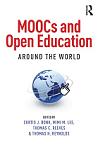
may be a book launching of the Korean version of my new MOOCs and Open Ed Around the World book on Saturday May 28 th after the KAIEM conference at
Kyung Hee U in Seoul. The translators have worked fast for us! I will meet with
many of the Korean translators for dinner that night after speaking about the
book and
perhaps the special issue at the conference. I guess I should send a few copies
of the English version over to the conference. I will speak at 8 places over
the first week I am there. I have sent over some of my Adding Some TEC-VARIETY books to give away at each stop (even though it is free online as a PDF).
My Korea stops will include in this order:
Saturday May 28th: KAEIM (an ed media
conference; 1 pm talk);
Monday May 30th: Ewha Womens University and the Korean National Open U (KNOU). The KNOU talk will include people from a company called
Tekville; Techville builds products for K-12 teacher communities;
Tuesday May 31st: Chosun University (in Gwangju in the south). I will see my former student Dr. Jieun Lee;
Wednesday June 1st: Korea University (2 talks); I will see my former student Dr. Minyoung Doo;
Thursday June 2nd: Chungbuk National U (2-3 hours
south of South where my long-time colleague and friend from graduate school days, Dr. Okhwa Lee works. Also there is my former student and close friend Dr. Paul Byun)
Friday June 3rd: Starting at the Institute of National Lifelong Education and ending at Seoul
National U (organized by my good friend Dr. Ilju Rha).
After those talks, I will take off 4 or so days to
travel around with different friends each day. Perhaps I will get a new suit. I need a blue one and perhaps another white one or maybe a green one.
Labels: Auckland, e-learning, Gandalf, Hamilton, hobbit, Korea, New Zealand, Seoul |
|
|
|
|
|
|