|
|
The Annual Pilgrimage to Milwaukee and Madison for the Annual DTL Conference |
| Friday, August 05, 2016 |
What happens ever summer? Answer: A trip or two to my roots in Wisconsin. And one such trip is coming up next week. Hooray!
I cannot wait to go to Milwaukee (where I was born) and the University of Wisconsin Madison (where I went to graduate school). I am heading up Monday morning for the 32nd Annual Distance Teaching and Learning Conference in Madison August 9-11. There is no better place than Madison and Milwaukee in the summer. So many festivals in Milwaukee. And such a delightful ambience in Madison in the summer. I miss that place every day.
My car (a 2004 blue Honda Pilot) will eventually be quite full. Full of MOOCs books to give away at the conference and many suitcases and dishes for my brother Richard. And full of people. First, I will pick up my former student Dr. Minkyoung Kim in Bloomington. We will drive through Chicago (the mess that it is) and pick up Dr. Tom Reeves from the University of Georgia in the Milwaukee airport Monday afternoon. We will stay a night in Milwaukee so I can show them around places like the Milwaukee Art Museum. I will also show them the house in West Allis (2468 S. 94th Street) that I grew up in on the west side of Milwaukee. Unfortunately, it is presently for sale (check out my old house; see also pictures below). My mom passed away back in December and my sisters and brothers are now selling it. This will likely be the final time that I see my old house and neighborhood. Sadness. I will come back to Milwaukee on Friday to drop off Tom Reeves at the airport and then go to the State Fair with one of my brothers (Richard) and best friend Stan Lowe. It is an annual pilgrimage.
There is much to do at the conference in Madison. I have been prepping for weeks. I have a spotlight session on the personalization of MOOCs. And I have another spotlight session on how to use Web and videoconferencing to bring in experts, former students, and others to one's classes and events. Third, I have been asked to introduce the recipient of the Charles and Mildred Wedemeyer Award for Distance Learning Practitioner. I was fortunate to receive the award two years ago and so I have been asked to be involved this year. And fourth, I am on a closing panel. These events are detailed below.
Let's start with the ending panel. There are tons of brilliant people coming this year as keynote, spotlight, and invited speakers. I am truly impress with the work that my friends Les Howles and Kimary Peterson have put into this year's event. Many of these people will join me on the conferencing closing panel, Stumble, Fall Rise Again: From Failure to Transformation Change. During that panel, we will all relate stories where things did not work out as planned. It should be fun. Many of my friends and colleagues are also on the panel; they include, Ellen Wagner, Simone Conceicao, Michael G.
Moore, Tom Reeves, Darcy Hardy, Ray Schroeder, and Michelle D.
Miller. Les Howles will moderate it. Many of these people will join me for dinner on Tuesday night at the Great Dane Pub and Brewery restaurant in Madison near the Capital.
In one Spotlight session on Wednesday afternoon, Personalizing the MOOC: Insights from Experts Around Planet Earth, Tom Reeves
and I will not only update you on the present state of MOOCs, but we will discuss
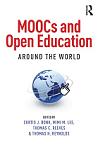
what contributors to our book, MOOCs and Open Education
Around the World published a year ago, have since recommended to us about
how to personalize and be culturally sensitive when designing and delivery a
MOOC. We will also present some brand new data collected by my research team and I during the past
month on how 150 MOOCs instructors from varied disciplines around the world
have personalized their MOOCs.
A book discussion and signing session will follow immediately after the spotlight session where people can
receive a signed copy of our MOOCs and Open Education Around the World book for free (I should mention that Mimi Lee at the University of Houston and Tom Reynolds at National University are co-editors but they unfortunately cannot make it to the conference in Madison). Book signings and discussions are always fun. I will also do a "Book Nook" discussion on Thursday morning at 9 am. I am really looking forward to presenting at this conference with my super-splendid colleague Dr. Tom Reeves. He and I make for a fun team despite a bit of wear in the tires.
As indicated, in another spotlight session, Through the Words of Experts: Lessons Learned from Over Two Decades of Synchronous Conferencing, my former graduate student, Dr. Minkyoung Kim, and I will detail many ways that Web and videoconferencing can be used to bring in guest experts. Here is the abstract: "The tools for connecting students with experts around the world have
enabled a new type of learning apprenticeship. No longer must your
instructors and peers come from your own institution or organization.
This talk will detail a series of pedagogical innovations and lesson
learned from Web and video conferencing experimentations meant to extend
the classroom to the world community. Tools such as Adobe Connect,
Google Hangouts, Skype, and Zoom will be highlighted. Extensive examples
and advice will be provided."
I have dozens of such examples that I can share. Most of the time it is a eye-popping and head-knocking sort of experience. People see new perspectives and ideas. They learn about different cultures and the importance of course content in various regions of the world and disciplines. And they better appreciate the content being taught in the course. These are exciting times for work in this area of global education with technology.
I should point out that this will be Minkyoung Kim's first presentation since passing her dissertation defense in June. She heads to a position at Texas Tech shortly after the conference. Congrads to her!
So, that is it for my brief recap for next week. Madison is so much fun in the summer. I will give Tom and Minkyoung and Rich Culatta a tour of the UW Campus on Tuesday afternoon. We will try to meet up with my former student Kurt Squire for ice cream at the main union overlooking Lake Mendota as part of the tour. It will be great to see my Kurt for the last time in Madison. He and his wife Constance Steinkuehler recently accepted jobs at UC Irvine.
You can find my slides in my archived talks in TrainingShare.com. In the meantime, below are pictures of the front and back of the house that I grew up in there in West Allis, Wisconsin (along with 2 brothers and 2 sisters). I will miss the old place when it is sold. Pictures of the inside can be found in the link above. One bathroom and three bedrooms for 7 people was not easy. Eventually, my father built a 4th bedroom and 2nd bathroom in the basement. Enjoy the home tour! Perhaps you might want to buy it? Let me know.
Labels: Charles Wedemeyer, cultural sensitivity, Les Howles, Madison, MOOCs, personalization, Tom Reeves, videoconferencing, Web conferencing, Wisconsin Distance Teaching and Learning Conference |
|
|
|
|
|
Bringing Experts Around the World to Your Class: One Interview, Two Videos, and Five+ Lessons Learned |
| Friday, March 29, 2013 |
Introduction. Back in mid February, some folks at our Center for Innovative Teaching and Learning (CILT) here at Indiana University (IU) asked me if they could interview me about how I bring in experts into my classes via videoconferencing, Skype, Web conferencing, chat, and so on. I have been doing such activities for nearly two decades now and so they were interested in capturing some ideas from me. The video interview is now posted as a Spotlight report for faculty development purposes here at IU (Bringing Experts Around the World to Your Class). There are two short videos along with a few paragraphs of text from that interview. Below I explain more about my rationale for engaging in such instructional activities.
Thinking back. Way back in 1995, Dr. Ken Hay and I team taught a course on "Interactive Tools for a Learning Community" between IU Bloomington and IUPUI in Indianapolis. In the middle of the semester (see Week 11 of old syllabus from 1995), we had Elliot Soloway from the University of Michigan and David Palumbo from the University of Houston at Clear Lake come into our class via CU-SeeMe. At the time, CU-SeeMe was free while other Web conferencing options at the time were highly expensive. The class was taught each week via videoconferencing using PictureTel technology. With the savvy tech help of Dr. Bob Appelman, we combined to videoconferencing systems together. It was pretty cool at the time. In fact, we published an article about the event in Educational Technology magazine.
Added to that course was a weekly asynchronous discussion using VAX Notes. There were several students in that course who debated and criticized the ideas in the articles we read that particular week from Drs. Soloway and Palumbo. They did not believe that computer programming could impact thinking as they had described (i.e., the expression many researchers used in the 1980s and 1990s was "Logo as Latin"...you learned a computer programming language and your thinking would improve just as it would from learning Latin or so they thought). Anyway, those same students who discarded these ideas and perspectives, were nodding their heads in agreement with everything that Elliot and David said when we brought them in via CU-SeeMe. These students found out that one article did not represent a person and that people's ideas can (and do) change over time.
Lesson Learned #1. Asynchronous activities first. Then try synchronous. It whacks students in the side of the head and kicks them in the seat of the pants. They see new ideas and perspectives. And they rethink on their previous perspectives and biases. Of course there was another factor--Elliot Soloway looked like Santa Claus when projected through low bandwidth on CU-SeeMe. Anyone in the room at the time had to love him. In fact, a professor walking by my classroom stopped by and sat in when he saw what we were up to.
While that was a fascinating experience with Elliot and David back in 1995, I have had dozens and dozens of guests around the planet since that time. In fact, a few years ago, I tried this technique once again (sync then async) with the world famous instructional designer, Dr. David Merrill. Worked fabulously then too.
This week, I had my former student, Dr. Kira King from Orlando come in and chat about her different work-related experiences in instructional design and development since leaving IU 15 years ago. While she is the healthcare field now doing scenario-based learning for interactive simulations, she also have experience working for with museum schools, the World Bank Institute, the military, financial services companies, and the Disney Institute (i.e., a wine tasting course). My class topic was on collaborative technologies and so we planned to discuss our 1998 book, Electronic Collaborators: Learner-Centered Technologies for Literacy, Apprenticeship, and Discourse, but we never got to that since her work experience was so interesting and important to share. It was another fantastic week of intraplanetary sharing.
I must admit that the idea of bringing Kira in dawned on me later than normal. In fact, I called Kira last Sunday night between NCAA basketball games. I needed her presence less than 24 hours later. It was after 9 pm EST and she had gone to bed early that night. I woke her up. Yet, she was gracious and said no problem, "I would be happy to talk to your class tomorrow night." Whew. I am fortunate to have such wonderful friends and former students.
Lesson Learned #2. The world is open. You can alter your class at any moment with new resources, guest experts, activities, and collaborations. There is an endless sea of expertise to tap into. And sometimes you just have to go with the flow and see what happens. Sometimes it works great and sometimes not as great. Just be open and flexible and the good times will vastly outweigh the not so good.
A few years ago, I invited my friend John Traxler at the University of Wolverhampton in the UK to discuss mobile learning with my online students via Adobe Connect. The following year, Paul Kim from Stanford was the guest when that topic came up but this time we used videoconferencing since it was a face-to-face class. Students learned so much from Paul that they are still talking about it. A few weeks before Paul came in, Anya Kamenetz discussed her DIY-U book with my class. That sure was fun! Anya and I just happen to be the keynotes for the UA Systems Scholars Institute in Huntsville, Alabama in a few weeks.
I also like to bring in people from other countries. For instance, George Siemens from Athabasca University in Canada came in to discuss his theory called "Connectivism." His Canadian colleague, Stephen Downes, has appeared via Webcam to present on open and personalized learning environments. Very frank and impressive stuff always from Stephen. A few weeks later, Yayoi Anzai has made an appearance from Tokyo talking about her highly creative use of blogging, podcasting, and wikis for learning English. I was flying home from Saudi Arabia that day and my assistant Seolim Kwon handled it. I arrived for the last few minutes after more than a day of travel. As is clear by now, each of these synchronous events have been highly memorable and rewarding.
While these people were all great, I rarely bring anyone back; at least not for a few semesters or years. In Kira King's case, it had been about 13 or 14 years since she last was a guest in my class.
Lesson Learned #3. Despite the fact that you can connect with anyone at any time and invite him or her to join your class, you really should plan ahead. See the articles, resources, and activities that you have organized. Is there someone whose articles you are reading that are highly complex or complicated? Might there be one on a recently popular topic? Is there someone you know or met recently who would excite your students? If so, contact them.
More recently, Ray Schroeder from the University of Illinois at Springfield discussed massive open online courses (MOOCs) as well as related changed about to impact higher education (that was February 2012). That same month, George Veletsianos from UT Austin was a guest who talked about adventure learning as well as social media.
During the current semester (Week 8), Dr. Rey Junco was our expert guest who presented his research on social media (i.e., Facebook, Twitter, chat, etc.). Once Rey agreed, I took screen shots from various articles that he had published during the past few years and uploaded them to a PowerPoint deck. During our Adobe Connect meeting, he responded to most of those and just told me to skip on any that he felt were not important to the points he was making. After that, Rey responded to student selected quotes from his various articles (I had asked my students to bring in a few for him to respond to). Rey was highly skilled at performing in such a "hot seat." He is about to move to nearby Purdue University. It was be great to have him in the neighborhood.
In Week 6, we also had Steve Carson from MIT give us a fascinating look at open education and the impact it is having around the globe. Again, I brought in a few screen shots from one of Steve's papers for him to respond to. In Week 3, Peter Young from San Jose State University discussed digital book and mobile projects that he has been involved with.
Lesson Learned #4. You can make it easy on your guests by preparing questions, screen shots, or quotes for the them to comment on or respond to. If it is an open and flexible environment, the guest can skip any item that you bring up. This makes for a more relaxing yet highly focused discussion on the ideas and relevant content produced by that individual.
So many possibilities for global and cross cultural interaction today. What fun times these are! This semester, I am experimenting with the combination of Google Hangouts and Adobe Connect Pro. We use Adobe Connect for PowerPoint presentations and Web explorations, whereas Google Hangouts is used for chats and reflections about such content as well as the weekly readings, videos, and Web resources from the monster syllabus. Keep in mind, however, that the limit is 10 people in a Google Hangout, unless you move up to Google On Air.
I have had many more guests. In fact, last fall, I started my semester with Michael Horn from the Innosight Institute discuss his recent articles on blended learning. The students in the course had not even been introduced to the course syllabus and expected activities. I decided to just jump in first thing with Michael. That was fun. He has the book with Clayton Christensen, "Disrupting Class: How Disruptive Innovation will Change the Way the World Learns." We used Adobe Connect with Michael as well as my other weekly guest experts that semester. This attendance was optional, we recorded each week so that students who missed could watch it later. I also posted the link each time we had a guest to my Facebook account and anyone in the world could lurk in. I think we had nearly a dozen guests last fall, including three on one night alone when we got to the topic of digital books. But please don't think I was slacking; in actuality, I also presented most weeks.
Lesson Learned #5. You (i.e., the instructor) are not vital the start or the end or any part of your class. You do not need to start the class with the all-too-boring reading of the syllabus. Try something new. Break it up. Bring in highly inspirational and talented people to excite your students about the content and different topics that you will be reading and learning about.
Takeaway. Why do I bring in guests with Adobe Connect or link to them with videoconferencing or Skype? Simple. I want to expand student minds beyond preset course materials and expectations. I want to build perspective taking and social cognition. Social cognition is the most vital skill that we can try to foster as instructors. I view this activity as part of a cognitive apprenticeship process. Clearly, in this age of information abundance, we (instructors) are concierges (see 2007 blog post on this notion). We challenge and support learners with the resources that we make available. Sure, my 75 page monster syllabus on Emerging Learning Technologies is a bit much. But you can challenge with much less.
One of my doctoral students, Miguel Lara, was aware of my use of guests. After obtaining a fulltime job at the CILT, Miguel asked me to talk about the topic as part of a faculty development effort here at IU. I think he did the later splicing of video snippets. Miguel and his colleagues finished the video (actually 2 parts) and posted it two days ago. They titled the episode or "Spotlight" report, "Bringing Experts Around the World to Your Class. You can read much more on my views on why I bring in guest experts from reading the article that Miguel posted. You will discover several more lessons learned. You will also find two short videos. As per below, these have also been posted to YouTube today.
Part 1: Benefits of Inviting Guest Experts (3:48)
Part 2: Expanding Global Awareness (2:17)
So will you be bringing guests into your class? Perhaps. If so, let me know how it went.
Note: I hope to post to my TravelinEdMan blog a few more times in the coming week. Perhaps one per day for the next few days. Not sure yet.Labels: Adobe Connect, CU-SeeMe, global awareness, global collaboration, guest experts, perspective taking, PictureTel, sharing, Skype, social cognition, videoconferencing, Web conferencing |
|
|
|
|
|
|