|
|
A Tribute to Larry Lipsitz and Memories of January 1986 including Ed Tech Magazine |
| Sunday, February 10, 2019 |
I have been meaning to post the tribute below for nearly two years now. Better late than never.
Tribute to Larry Lipsitz (lifelong educator, trailblazer in
the field of educational technology, and founder of Educational Technology Magazine
(a part-time venture in 1961, and a full-time business from 1969 to the last
issue in March-April 2017). Larry passed away at the age of 79 on November 4,
2016.
A
portion of the article below appears in the last issue of Educational
Technology Magazine which was edited by my good friend and colleague, Dr. Tom
Reeves at The University of Georgia.
Bonk, C. J. (2017, March-April). Larry
Lipsitz helped change my life. In D. Hlynka, & T. C. Reeves (Eds.).
Tributes and remembrances for Larry Lipsitz. Educational Technology, 57(2),
7-8. Available: http://publicationshare.com/13
(entire tribute to Larry Lipsitz: http://publicationshare.com/14)
Original (slightly longer) Article:
Larry
Lipsitz Helped Change My Life, by Curt Bonk, Contributing Editor of Educational
Technology, and Professor, Indiana University, Instructional Systems Technology
(IST) Department
My first memories of Educational Technology magazine
take me back three decades to January 1986. What a month it was. On Friday January
3rd, I spent my final day as an accountant and CPA in Milwaukee while working
in the high tech industry. I then packed my stuff that weekend and moved to frigid
and snow-filled Madison, Wisconsin for graduate school which was -19 F at the
time. In a night class the following week titled “Ed Psych 890: Theory:
Computer-Based Instructional Systems” taught by UW Professor Richard Lehrer, I sat
next to two people, Tom Reynolds and Okhwa Lee, who would become my best
friends and top colleagues to this day. I also remember walking into the
Teacher Education building a couple of weeks later on Tuesday January 28, 1986 and
a TV mounted in the hallway, to which everyone around me was transfixed, was
replaying the explosion of the Challenger space shuttle.
Suffice
to say, that one of the most pivotal months in my life. Among the more consequential
events was when I went to the School of Education library to work on an early
assignment for EdP 890 and opened up the new January-February 1986 issue of
Educational Technology. In it was an article by the famed Roger Johnson and
David Johnson brothers from the University of Minnesota on “Computer-assisted
cooperative learning.” I was hooked. Another article from a previous issue in
1983 on “What computer-assisted instruction can offer toward the encouragement
of creative thinking” by Joan Gallini directly addressed one of the reasons I
was in graduate school; i.e., to foster human thinking and teamwork with
technology. Both articles later found their way into my master’s thesis. Articles
in other issues of this magazine by folks like Robert Tennyson, David Jonassen,
Priscilla Norton, Dean Spitzer, and countless others helped me to ramp up
quickly and learn from the leaders in the field. In fact, in the fall of 1986,
I wrote a letter to David Jonassen after reading his Educational Technology article
on “Soft technologies: A paradigm shift for educational technology” and I
received a personally written response from David a few weeks later in my
mailbox at home. Email accounts would be assigned a year later.
Suffice
to say, opening any issue of Educational Technology was like being a kid in a
candy store. Little did I realize that I would later get to meet the editor of
that magazine during a symposium at the AERA conference in April 2004 in San
Diego (ironically, the editor of this article, Tom Reeves, was the featured symposium
discussant). Even less expected was that Larry would actively solicit an
article from me. How did he know my name? Why was he asking for an article from
me? Larry sat in the front row of that research symposium in San Diego in an
attempt to learn as much as he could about the research of the presenters. If
it was any good, they would be sure to get his business card and request for an
article. Clearly, Larry Lipsitz had a keen pulse on the field of educational
technology.
In
more recent years, Larry would call or email me from time to time to discuss
trends in the field and up-and-coming people whom he might contact for an
article or a book review. He would also confer with me about upcoming special
issue themes and potential contributors. His interests in educational technology
were not only wide, they were deep; with mental notes of previous authors,
ideas, models, frameworks, concepts, theories, etc., spanning more than five
decades. He was perhaps the leading historian and documentarian of our field.
It is in the privilege getting to work with passionate, optimistic, and
transformative people like Larry Lipsitz that I am most thankful that I left
the field of accounting three decades ago. Larry pushed not only the field of
education ahead in positive ways, but markedly impacted the human condition in
general. Thanks so much Larry for helping change my life and the lives of so
many more! You cannot be replaced. We all deeply miss you.
Curt Bonk
Professor
Indiana University
Bloomington, Indiana
November 30, 2016
Labels: Curt Bonk, David Jonassen, educational technology, Educational Technology Magazine, Larry Lipsitz, Larry Lipsitz Tribute, Okhwa Lee, Richard Lehrer, Roger and David Johnson, Tom Reeves, Tom Reynolds |
|
|
|
|
|
The Annual Pilgrimage to Milwaukee and Madison for the Annual DTL Conference |
| Friday, August 05, 2016 |
What happens ever summer? Answer: A trip or two to my roots in Wisconsin. And one such trip is coming up next week. Hooray!
I cannot wait to go to Milwaukee (where I was born) and the University of Wisconsin Madison (where I went to graduate school). I am heading up Monday morning for the 32nd Annual Distance Teaching and Learning Conference in Madison August 9-11. There is no better place than Madison and Milwaukee in the summer. So many festivals in Milwaukee. And such a delightful ambience in Madison in the summer. I miss that place every day.
My car (a 2004 blue Honda Pilot) will eventually be quite full. Full of MOOCs books to give away at the conference and many suitcases and dishes for my brother Richard. And full of people. First, I will pick up my former student Dr. Minkyoung Kim in Bloomington. We will drive through Chicago (the mess that it is) and pick up Dr. Tom Reeves from the University of Georgia in the Milwaukee airport Monday afternoon. We will stay a night in Milwaukee so I can show them around places like the Milwaukee Art Museum. I will also show them the house in West Allis (2468 S. 94th Street) that I grew up in on the west side of Milwaukee. Unfortunately, it is presently for sale (check out my old house; see also pictures below). My mom passed away back in December and my sisters and brothers are now selling it. This will likely be the final time that I see my old house and neighborhood. Sadness. I will come back to Milwaukee on Friday to drop off Tom Reeves at the airport and then go to the State Fair with one of my brothers (Richard) and best friend Stan Lowe. It is an annual pilgrimage.
There is much to do at the conference in Madison. I have been prepping for weeks. I have a spotlight session on the personalization of MOOCs. And I have another spotlight session on how to use Web and videoconferencing to bring in experts, former students, and others to one's classes and events. Third, I have been asked to introduce the recipient of the Charles and Mildred Wedemeyer Award for Distance Learning Practitioner. I was fortunate to receive the award two years ago and so I have been asked to be involved this year. And fourth, I am on a closing panel. These events are detailed below.
Let's start with the ending panel. There are tons of brilliant people coming this year as keynote, spotlight, and invited speakers. I am truly impress with the work that my friends Les Howles and Kimary Peterson have put into this year's event. Many of these people will join me on the conferencing closing panel, Stumble, Fall Rise Again: From Failure to Transformation Change. During that panel, we will all relate stories where things did not work out as planned. It should be fun. Many of my friends and colleagues are also on the panel; they include, Ellen Wagner, Simone Conceicao, Michael G.
Moore, Tom Reeves, Darcy Hardy, Ray Schroeder, and Michelle D.
Miller. Les Howles will moderate it. Many of these people will join me for dinner on Tuesday night at the Great Dane Pub and Brewery restaurant in Madison near the Capital.
In one Spotlight session on Wednesday afternoon, Personalizing the MOOC: Insights from Experts Around Planet Earth, Tom Reeves
and I will not only update you on the present state of MOOCs, but we will discuss
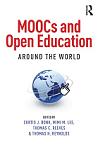
what contributors to our book, MOOCs and Open Education
Around the World published a year ago, have since recommended to us about
how to personalize and be culturally sensitive when designing and delivery a
MOOC. We will also present some brand new data collected by my research team and I during the past
month on how 150 MOOCs instructors from varied disciplines around the world
have personalized their MOOCs.
A book discussion and signing session will follow immediately after the spotlight session where people can
receive a signed copy of our MOOCs and Open Education Around the World book for free (I should mention that Mimi Lee at the University of Houston and Tom Reynolds at National University are co-editors but they unfortunately cannot make it to the conference in Madison). Book signings and discussions are always fun. I will also do a "Book Nook" discussion on Thursday morning at 9 am. I am really looking forward to presenting at this conference with my super-splendid colleague Dr. Tom Reeves. He and I make for a fun team despite a bit of wear in the tires.
As indicated, in another spotlight session, Through the Words of Experts: Lessons Learned from Over Two Decades of Synchronous Conferencing, my former graduate student, Dr. Minkyoung Kim, and I will detail many ways that Web and videoconferencing can be used to bring in guest experts. Here is the abstract: "The tools for connecting students with experts around the world have
enabled a new type of learning apprenticeship. No longer must your
instructors and peers come from your own institution or organization.
This talk will detail a series of pedagogical innovations and lesson
learned from Web and video conferencing experimentations meant to extend
the classroom to the world community. Tools such as Adobe Connect,
Google Hangouts, Skype, and Zoom will be highlighted. Extensive examples
and advice will be provided."
I have dozens of such examples that I can share. Most of the time it is a eye-popping and head-knocking sort of experience. People see new perspectives and ideas. They learn about different cultures and the importance of course content in various regions of the world and disciplines. And they better appreciate the content being taught in the course. These are exciting times for work in this area of global education with technology.
I should point out that this will be Minkyoung Kim's first presentation since passing her dissertation defense in June. She heads to a position at Texas Tech shortly after the conference. Congrads to her!
So, that is it for my brief recap for next week. Madison is so much fun in the summer. I will give Tom and Minkyoung and Rich Culatta a tour of the UW Campus on Tuesday afternoon. We will try to meet up with my former student Kurt Squire for ice cream at the main union overlooking Lake Mendota as part of the tour. It will be great to see my Kurt for the last time in Madison. He and his wife Constance Steinkuehler recently accepted jobs at UC Irvine.
You can find my slides in my archived talks in TrainingShare.com. In the meantime, below are pictures of the front and back of the house that I grew up in there in West Allis, Wisconsin (along with 2 brothers and 2 sisters). I will miss the old place when it is sold. Pictures of the inside can be found in the link above. One bathroom and three bedrooms for 7 people was not easy. Eventually, my father built a 4th bedroom and 2nd bathroom in the basement. Enjoy the home tour! Perhaps you might want to buy it? Let me know.
Labels: Charles Wedemeyer, cultural sensitivity, Les Howles, Madison, MOOCs, personalization, Tom Reeves, videoconferencing, Web conferencing, Wisconsin Distance Teaching and Learning Conference |
|
|
|
|
|
Sharing the loss of my dear friend Jay Cross |
| Saturday, November 07, 2015 |
Hello my friends. It has been a tad bit more than two months since my last post. The time has come despite the sleepiness. I am quite weary for several reasons but I feel the need to stay up tonight and grasp for air and jot down some thoughts.
You see, two weeks ago, I was in Hawaii for the annual E-Learn conference (invited panel session). And this past week, I have been in Indianapolis while attending the 2015 AECT conference. In fact, yesterday morning, two of my most excellent colleagues (Dr. Tom Reeves from the University of Georgia and Dr. Mimi Miyoung Lee from the University of Houston) and I had a special presidential session at AECT on best practices for cultural sensitivity in MOOCs (slides and handouts). This session was based on our newly edited book with Routledge on MOOCs and Open Education Around the World.
A few hours later, Mimi and I got an award for our paper on the self-directed online learning goals, achievements, and challenges of MIT OpenCourseWare subscribers. It is great to get such feedback immediately after publication. After that, there was the closing ceremony and other events. Suffice to say, it was a highly active week (or couple of weeks) and hence I am most tired. But I feel that I must soldier on and blog now.
Why must I blog tonight? Well, I just found out that we have lost one of our foremost of learning leaders...my dear dear, friend Jay Cross. See link to blog post from Jane Hart below that one of my former
students just sent to me as well as the post from Clark Quinn. I am sure many more will arise in the coming days.
If you have not heard of Jay, please explore his homepage or whatever will replace it. Jay was always insightful, straight-shooting, and an immense
joy to talk to. He was a highly trusted friend who had the unique ability and
previous experiences to straddle and make sense of a wide array of emerging learning
trends. He could also think about how each of these trends or new approaches to learning impacted different educational sectors and then he would quickly write some engaging piece of prose about it. In it, he might discuss various economic, educational, or social problems that it might directly or indirectly address.
I feel fortunate to have corresponded with him recently…and
give him some feedback on one of his latest projects; namely, "Real Learning." In retrospect, I am delighted that he had reached out to talk to me. But that is Jay. It seems
that Jay’s last Internet Time blog post was a few days ago on this topic: Real Learning: Macro and Micro, Jay Cross, Nov., 4, 2015
He made a second post that day related to the Brain Matters conference in
which he was to keynote this coming Tuesday afternoon: Brain Matters, Jay Cross, Nov 4, 2015
We are fortunate that Jay made a recent video on Real Learning, October 24, 2015 (3:10). Read more details about the Real Learning project here or find some actual content or details here.
If one were to search for the word genius in a virtual encyclopedia, he or she might find Jay Cross as an example. I wish I could write like Jay. I wish I could read like Jay. Gosh I do wish I were half as smart as Jay. As Clark Quinn mentioned in his blog post, that man could synthesize a ton of stuff! And I truly wish I could offer you a recap of his life right here, right now. I wish I could stay awake for 48+ more hours straight so I could come close to providing a recap or overview piece that I am proud of. This will have to do. We all now suffer from the loss of one Jay Cross.
We/I have lost a true friend. I still remember meeting him
about 13-14 years ago at the E-Learning conference in April 2002 in DC which I believe Elliott Masie hosted. Near the end of the conference, there was a group of people sitting around various tables and reflecting on how the conference went. My friend Dr. Ellen Wagner pulled me aside and told me that I had to meet a guy sitting with a group of people at a nearby table. His name was Jay Cross and he was among those who 5 years earlier had become known for a new trend called E-Learning. We had a fascinating conversation that day and dozens of times after. There is no one out there with whom I can have candid feedback about pretty much any learning question that I might come up with. Jay knew pretty much everyone and everything in the field. He was a mentor, confidant, guide, inspirer, listener, creator, experimenter, and world knowledge synthesizer. No one like him in the world.
Whether Jay or someone else had coined the term e-learning mattered little. What mattered was that there was something unique that had emerged for delivering instruction to masses of people around the planet. Jay recognized this technological event was anything but ordinary. In fact, Jay himself was anything but ordinary. I was delighted that Ellen Wagner had pointed him out to me. We soon became good friends.
Jay seemed to know everybody. He certainly interviewed or reviewed some of the foremost authorities in learning and technology in his Internet Time blog. So much history of the fields of training and education, learning technology, e-learning, computer science, organizational culture, performance improvement, and business management in those posts. A college professor might assign his or her students to scour through Jay's Internet Time blog (as well as other resources from Jay Cross) and find some of these excellent historical pieces and hold class discussions on them. In fact, I may try this idea out tomorrow with my class.
A decade ago, when I was working on my monster book, " The Handbook of Blended Learning: Global Perspective, Local Designs," I felt fortunate that Jay agreed to do one of the two forewords. The other foreword was from the well known scholar, Dr. Michael G. Moore at Penn State. Jay's advice in that article was spot on as usual. Now that Jay has passed and that particular book is nearly a decade old, I decided to send email asking the good people at Wiley/Jossey-Bass if I can post the forewords to the Blended Learning Handbook to my PublicationShare website. I have taken the liberty of posting them for now and will remove it if they say no.
Jay Cross and Michael G. Moore. (2006). Forewords to the Handbook of Blended Learning: Global Perspectives, Local Designs. In C. J. Bonk & C. R. Graham (Eds.). Handbook of blended learning: Global Perspectives, local designs. San Francisco, CA: Pfeiffer Publishing.
As Jay points out, "The ideal blend is a blend of blends." See Jay's Figure F.1. Dimensions of the Blended Learning Stew. Thanks for those insights on blended learning Jay!
At the end of the day, Jay Cross was a champion of others. He would interview them. He would write to them and ask their opinions and later promote them when and where he could. He provided such services for me on many occasions. Jay would also organize teams of people to discuss new trends and innovations or to respond to some of his own ideas and recent writings. Examples of such team meetings might include ideas about new forms of conferences or meetings, some new synchronous conferencing technology, discussing various informal learning examples, and/or pretty much anything you or he might dream up. In addition to those group meetings, Jay would often gin up a novel idea and solicit feedback on it. Across it all, he was amazing.
I interacted with Jay on many occasions since that first meeting. Among them was the American Educational Research Association (AERA) meeting in San Francisco on April 10, 2006. My long-time friend and colleague, Dr. Kim Foreman, arranged for a special event over at San Fran State University that night including Ke Zhang, Bob Reiser, Brian Beatty, Jay Cross, myself, and others. I spoke on blended learning. I think Bob Reiser from Florida State University discussed some aspect of corporate training or human performance technology as did Jay. Many of my current and former students attended the event. See pics below. Unfortunately, of the five people in the first few pictures below, both Kim and Jay are now deceased (see my August 20, 2010 blog post on Kim).
I tried to get Jay to do the "Indiana I" with us, to no avail.
Jay and I both delighted in the overflowing crowd that was attracted that evening. Standing room only and many people sitting on the floor at SFSU.
Jay dazzled the crowd.
Then we went off to dinner. I still could not get Jay to do the "Indiana I" with a group of my current and former doctoral students at IU.
A few years later (January 27, 2009 to be exact), my colleague, Dr. YaTing Teng, and I had he privilege of walking the streets of Berkeley with Jay. And of course we grabbed some excellent lunch and he told us many a fine story. I cannot remember why I was in the Bay area that day (I will assume that I was at a conference of some type), but I am glad I was able to stop in to see Jay.
See below...unfortunately, it was not Jay's car, but why not take it for a spin? Jay seemed to know everybody except the owner of this car. Too bad!
Just a few months later, I had the opportunity to visit Jay again. This time I was at his house on April 4, 2009 (8 years to the day after MIT announced its OpenCourseWare project and 15 years to the day since Netscape went public; if interested, see my recent article on this). A few pictures from this visit are posted below. Jay was interviewing me about my World is Open book at the time and posting it to YouTube for his newest project and broadcast channel. What a beautiful area to live. Needless to say, I was jealous.
Jay invited several others and had a "Learning Irregulars" meeting. Our mutual friend, Clark Quinn, stopped by for it and is in a couple of the pictures with us below. Clark is in the red sweater. I am in the red shirt and tie. And Jay has his Hawaiian shirt on. Enjoy.
"The World is Open" pose with Jay Cross and Clark Quinn.
Jay gave me a tour of his lovely backyard. Then it was time for business.
There have to be hundreds of recordings of Jay on the Internet. Someone might want to compile them.
I learned the value of signing anything you give away form my dear friend Jay Cross.
I miss him already and I am sure many of you do too. There is no one in the world quite like Jay Cross.
Bonus pics with Jay from the Emerging E-Learning (EMEL) conference in Abu Dhabi, UAE, September 2-5, 2004:
A couple of days after writing the above blog post on remembering Jay Cross, my friend Vance Stevens reminded me of the class that I taught with Jay from Abu Dhabi in the UAE to Bloomington, Indiana in the USA late night on September 3, 2004 (it was actually the wee hours of September 4th where we were--there was a 9 hour time zone difference according to my notes from that day).
The videoconferencing system worked marvelously. Jay was a good sport and most excellent friend in staying up with me late that night. I think it was one of my doctoral students, Nari Kim, who handled the equipment for me in Bloomington. Thank you Nari (11 years too late)!
Was it my "The Perfect E-Storm" talk or my talk on "Navigating the Myths and Monsoons of E-Learning Strategies and Technologies." Either way, it was fun to use raincoats and umbrellas in the UAE where it rarely rains.
My class back in Bloomington looks on (including Jung Won Hur, Gina Anderson, Fang Fang, Mei-ya Liang, etc.). I have even found the syllabus: http://php.indiana.edu/~cjbonk/p600syl2.html. It was taught to both our Bloomington and Indianapolis campuses.
The day before (9/2/2004), we had lunch in the Sheikh Nahyan's Palace in Abu Dhabi. So much food! Anyone like goat, donkey, or camel? Well, if not, there is plenty of watermelon to go around.
And after lunch, was a business meeting of sorts.
In the final pictures below, Jay Cross and I were joined by another keynote speaker--my good friend John Hedberg (from Macquarie University in Australia). We closed out that conference on the afternoon of September 5, 2004 with a reflective drink in the hotel lounge. Speaking of John, he will remember me out on the balcony and getting locked out of my room one very hot morning during that conference and not being able to get back in (after waking up the first day with jet lag and not remembering what my room number was so no one could find me and let me in from the heat). What a nightmare that was!
Seems a good picture to end on...(unless I find a better one later). Goodbye Jay. Missing you even more now after posting these fond memories.
Short Addendum: Learning Trends from Elliott Masie today (11/11/2015) mentioned David Kelly's excellent curation of the stories about Jay Cross: An Industry Remembers Jay Cross, November 11, 2015. And Jane Hart's Twitter Tributes to Jay is now up to 286 comments. And this "In Memoriam: Jay Cross" piece from Learning Solutions also from November 11th is worth reading. He certainly had many fans, friends, and fellow Web-based learning travelers.
It might also be useful to post the obituary (My Obituary) that Jay wrote for himself back on June 20, 2015 as well as what seems to be his last blog ("plog"--or his "Personal Progress Blog") post written the day he died about going back for his 50th college reunion at Princeton this coming May 2016 (Going back, going back, going back to Nassau Hall by Jay Cross). Indeed, Jay had a multitude of writing outlets. He serves as a role model not just for being a highly productive writer and thinker, but on how to be a genuinely caring and helpful human being who wants the world to learn in whatever ways possible and in an effort to help others not only be more productive but to be happy in the process. I truly am blessed and quite happy to have met and worked with Jay Cross.Labels: AECT, blended learning, Clark Quinn, cultural sensitivity, E-Learn, Ellen Wagner, Elliott Masie, Informal Learning, Internet Time blog, Jane Hart, Jay Cross, MIT OCW, MOOCs, real learning, Tom Reeves |
|
|
|
|
|
|